Summit Therapeutics: One Man, One Drug and a $500 Million Check
What is the full story of Summit Therapeutics, from its listing to the FDA rejection?
Summit Therapeutics, a small British antibiotics company controlled by the investor Robert Duggan, agreed in 2022 to pay $500 million upfront for rights to Akeso's cancer drug ivonescimab in the US, Europe, Japan and other markets, and its value rose from $137 million to about $27.1 billion on trials Akeso ran in China. In November 2026 the FDA declined approval: its letter said the progression benefit could not be shown to apply to US patients, because 93% of events occurred in patients enrolled in China, and that the modest benefit, without a significant survival gain, did not outweigh the added toxicity.
The short version
- Summit was a small British drug developer whose Duchenne drug failed in 2018 and whose antibiotic missed its main goal in 2021. Robert Duggan bought control in 2019; he owns 71.8% today.
- In 2022 it agreed to pay $500 million upfront for ivonescimab, a lung cancer drug from China’s Akeso; Duggan lent most of the money. The $5.0 billion headline is mostly milestones.
- Trials Akeso ran in China lifted Summit’s market value from $137 million to about $27.1 billion by April 2025.
- Summit’s own global trial delayed cancer progression but missed its survival goal (p=0.057 against 0.0448). Summit disclosed then that the FDA considered a significant survival benefit necessary, and filed anyway.
- In November 2026 the FDA declined approval. Its published letter said the progression benefit couldn’t be shown to apply to US patients, because 93% of progression events came from patients enrolled in China, that final survival wasn’t significantly better, and that the modest benefit didn’t outweigh the added toxicities. It raised no manufacturing issue.
- What’s next is Summit’s own first-line trial, HARMONi-3. Summit says its cash, including AstraZeneca’s $2.0 billion, covers at least the next 12 months.
A letter on a Sunday
On Sunday, Nov 15, 2026, Summit Therapeutics announced from Miami that the Food and Drug Administration had turned down its application to sell ivonescimab, a lung cancer drug it had licensed from China’s Akeso. The agency’s letter, dated Nov 13 and since published in the FDA’s public database of complete response letters, said: “Substantial evidence of effectiveness is not established and the benefit-risk profile does not support approval.” Summit’s announcement gave the reason as the lack of “a statistically significant overall survival (OS) improvement.”
Summit had disclosed that requirement. Eighteen months earlier, when its global trial delivered a mixed result, the company had written: “The FDA noted that a statistically significant overall survival benefit is necessary to support marketing authorization.” Summit filed anyway. On Monday its shares fell 16.5%, to $11.82, a market value of about $9.5 billion for the common shares, or about $10.7 billion including the shares AstraZeneca’s preferred stock converts into (our calculation). The SPDR S&P Biotech ETF fell 3.1% the same day. Summit’s shares had already fallen 20.7% in the four trading days before the decision date.
“With five positive Phase III studies between Summit and Akeso, nothing changes with respect to our ever-growing belief in the opportunity for ivonescimab,” said Robert W. Duggan, Summit’s chairman and co-chief executive, who owns 71.8% of the company.
This is the story of how a small British antibiotics company became, in two and a half years, a bet worth about $27.1 billion on a drug from China, controlled by one investor who paid for much of it himself. It is also a story about evidence: what trials run in China could show the market, and what a global trial had to show an American regulator. It is told from the record: filings, company statements, regulators’ documents and the prices investors paid on the days the news arrived.
Summit's market value, 2019 to 2026 (weekly, $ billions, log scale)
About $137 million the week before the Akeso deal in December 2022, Summit's market value passed $20 billion in September 2024 and, on a daily basis, peaked at about $27.1 billion in April 2025, before the survival results and the FDA's rejection took it back below $10 billion.
- Duggan buys in
- Antibiotic fails
- Akeso deal
- China trial beats Keytruda
- Peak, then survival data
- Global trial: survival miss
- AstraZeneca $2B
- FDA rejection
Market value, $ billions (log scale)
Weekly closes times the latest share count on a filing cover page on or before that date; before September 2020 the count is in American depositary shares (5 UK ordinary shares = 1 ADS). Excludes AstraZeneca's non-voting convertible preferred shares (about 109 million common shares if converted). Weekly closes miss single days: the closing high was $36.70 on Apr 24, 2025, about $27.1 billion. The last point is the Nov 18, 2026 close.
1. A company in Oxfordshire
Summit’s first drug failed before its new owner arrived. Its business began in 2003, as a drug developer near Oxford; the listed parent took the name Summit Corporation plc in 2007. It listed in London on AIM in 2004 and, in March 2015, on Nasdaq, selling American depositary shares at $9.90. Its prospectus offered two ideas: a pill to slow Duchenne muscular dystrophy by boosting a protein called utrophin, and an antibiotic for C. difficile, a gut infection that often comes back after treatment, which Summit later called a “precision antibiotic.”
The Duchenne drug went first. In June 2018 the company discontinued ezutromid after its Phase 2 trial, PhaseOut DMD, failed its primary and secondary endpoints; effects seen at 24 weeks, the company said, had not held at 48.
2. Mr. Duggan buys in
One investor bought control, and he had done it twice before. In December 2019 Robert W. Duggan, a California investor then in his mid-seventies, agreed to subscribe for 166,157,050 new Summit shares, with warrants, for $47.4 million; on its own, the subscription was about half of the enlarged share count. Three directors resigned, and Duggan and three other new directors joined the board.
His record followed a pattern: a large personal stake, his own money when the company needed it, and the top job. At Computer Motion, a California maker of surgical robots, he was a shareholder from 1989, chairman from 1990 and chief executive from 1997. In 2003, after years of patent fights, it merged with its rival Intuitive Surgical; Duggan, who owned about 21% of Computer Motion, received about 1.08 million Intuitive shares and sat on its board until 2011.
Then came Pharmacyclics, a struggling cancer-drug developer. He began buying its shares in 2004, owned about 17% by 2007, joined the board that year and in September 2008 became chairman and interim chief executive. When it was short of cash he lent it $6.4 million in 2008 and 2009 and bought $13 million of new shares in 2010 and 2011. The company’s proxy noted that he “has declined to receive any compensation, whether cash, stock or options.” In 2011 Pharmacyclics partnered its leukemia drug ibrutinib, later sold as Imbruvica, with Johnson & Johnson’s Janssen for $150 million upfront. In 2015 AbbVie agreed to buy Pharmacyclics for about $21 billion, $261.25 a share; the tender documents valued Duggan’s 13.6 million shares at about $3.55 billion, a gross figure; what he netted isn’t public. Forbes put his fortune at $3.0 billion that year.
In February 2020 Forbes reported that he had spent $75 million building a 65% stake in Summit. “It’s a good thing to do,” he told the magazine of the antibiotics bet; “we will see how well we can monetize it.” Including the shares he already held, he owned about 62.8% by April 2020. He became executive chairman in February and chief executive in April, and took no salary. Several of the new directors and managers had worked at Pharmacyclics, and a consulting firm run by Maky Zanganeh, a major shareholder who would become his co-chief executive, was hired to help with the trials. In September 2020 a new Delaware company replaced the British one as the listed parent; in 2024 Summit signed the lease for its Miami headquarters.
The antibiotic was the remaining bet. In December 2021 Summit said its Phase III trial of ridinilazole “did not meet the study’s primary endpoint for superiority” over vancomycin, the standard treatment, though fewer patients’ infections returned. “We believe this study was indicative of worthwhile work, as the knowledge that we have acquired as a team over the past 18 months is priceless,” Duggan said. The shares fell 48.0% that day. In March 2022 Duggan, by then the owner of about 70%, lent the company $25 million.
By Dec 1, 2022, Summit’s market value was about $137 million.
3. The $500 million bet
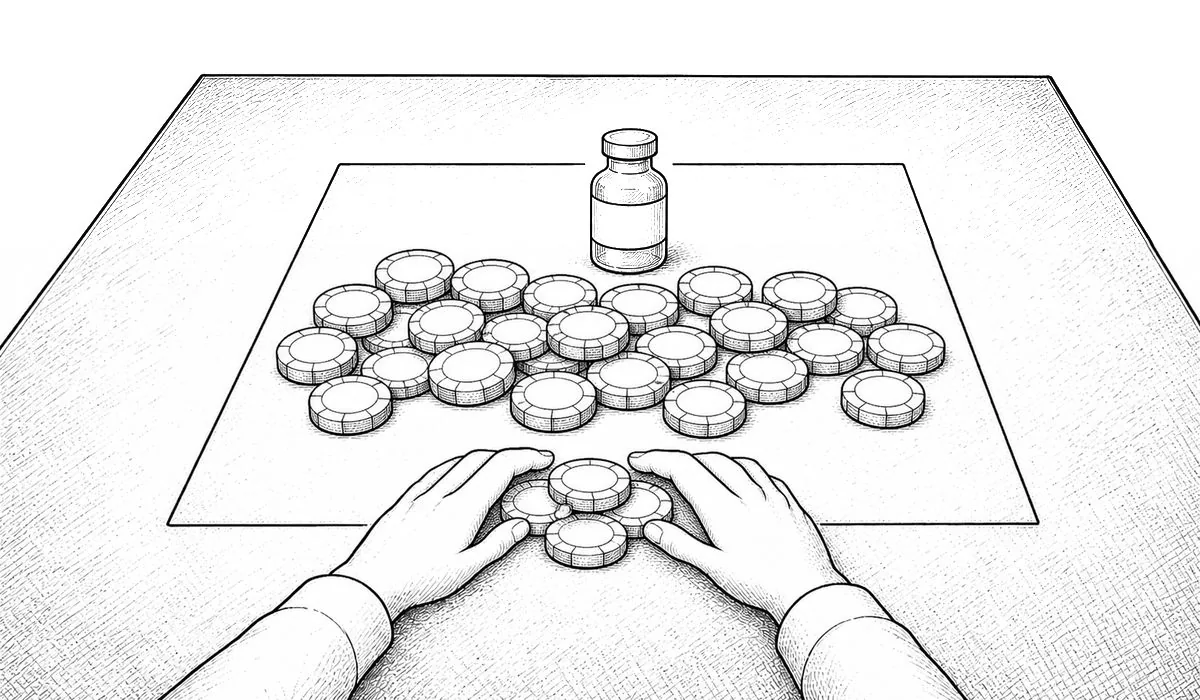
The deal that made Summit cost a tenth of its headline value, and its owner lent the money. Five days later, on Dec 6, Summit announced a deal with Akeso, a Chinese drugmaker listed in Hong Kong. It licensed ivonescimab, a single antibody built to block two targets at once: PD-1, the switch that immunotherapies such as Merck’s Keytruda turn off, and VEGF, a signal tumors use to grow blood vessels. Summit got the rights in the US, Canada, Europe and Japan; Akeso kept China. Latin America, the Middle East and Africa were added in 2024 for $15 million more upfront.
The headline number was $5.0 billion. The cash was a tenth of that. Summit agreed to pay “an upfront payment of $500 million,” and the filing set out the rest: “The total value of the upfront payment and potential milestone payments is $5.0 billion, as Akeso will be eligible to receive regulatory and commercial milestones of up to $4.5 billion,” plus low double-digit royalties on sales. Akeso took $25.1 million of the upfront in Summit shares.
Summit did not have $500 million. Its owner lent it: Duggan and Maky Zanganeh, his co-chief executive, signed $520 million of unsecured promissory notes, $500 million of them from Duggan, described in the filing as the “beneficial owner of approximately 81%” of the stock. The shares nearly tripled that day, rising 194.3% to $2.31.
The notes were repaid largely with more of Duggan’s shares. In February and March 2023 Summit sold $500 million of stock to all its shareholders in a rights offering at $1.05 a share, less than half the price on the day the deal was announced. Duggan paid $395.3 million of his subscription by cancelling the notes he held. Akeso’s founder and chief executive, Michelle Xia, joined Summit’s board. According to Akeso’s annual report, licence income, chiefly from Summit, made up about 65% of its 2023 revenue (our calculation).
The trade-off was plain in the terms: Summit bought the rights in its markets and took on the cost of proving the drug there, while Akeso kept China, the upfront payment and a claim on milestones and royalties if Summit succeeded.
The Akeso deal, in figures
- Signed Dec 5, 2022, announced Dec 6; closed in January 2023. Territories: the US, Canada, Europe and Japan; Latin America, the Middle East and Africa added in June 2024 ($15 million upfront, up to $55 million in milestones). Akeso keeps China and the rest of the world.
- Paid upfront: $474.9 million in cash plus 10 million Summit shares (in place of $25.1 million) in the first quarter of 2023, and $15 million in 2024. Summit expensed all of it as acquired research and development.
- Akeso’s 2023 licence income of RMB2,922.8 million divided by revenue of RMB4,526.3 million was 64.6%, about 65% (our calculation from its 2024 annual report).
- Still to come, if earned: up to $4.56 billion in potential milestones, comprising up to $1.05 billion regulatory and $3.51 billion commercial, plus low double-digit royalties (10-Q, Sep 30, 2026). Summit also buys part of its drug supply from Akeso.
- Funding: $520 million of notes from Duggan ($500 million) and Zanganeh ($20 million); a $500 million rights offering at $1.05 (476.19 million shares), of which Duggan paid $395.3 million by cancelling note principal; the last $100 million of his notes was repaid in September and October 2024.
- The stock: +194.3% on Dec 6, 2022, to $2.31; +589.2% from the close before the deal to 20 sessions later (our calculation from Yahoo Finance closes).
4. Results from China
For the next two years Summit’s value was built on trials it did not run: Akeso’s, in China. In May 2024 China’s drug regulator approved ivonescimab with chemotherapy for lung cancer whose EGFR mutation had stopped responding to targeted pills, based on Akeso’s HARMONi-A trial.
Then came a head-to-head test. On May 30, 2024, Summit announced that HARMONi-2, a Phase III trial in China in which ivonescimab alone was compared with Keytruda alone in untreated lung cancer, had met its primary goal: patients went longer before their disease progressed. Summit’s release described the trial as “conducted in China sponsored by Akeso, Inc. … with data generated and analyzed by Akeso,” and noted that no other Phase III trial in lung cancer was known to have beaten Keytruda head to head on that measure. “This is an historic moment,” Duggan said. The shares rose 272.1% that day, from $2.935 to $10.92.
The full data, released in September at the World Conference on Lung Cancer, showed a median of 11.14 months without progression against 5.82 months for Keytruda, a hazard ratio of 0.51, meaning about half the risk of progression or death at any point. The stock rose 56.0% the next day. Investors put in more money: Baker Bros. bought $200 million of stock at $9.00 in June, and a group of biotech funds and others, including related parties, $235 million at $22.70 in September. Summit repaid Duggan’s last $100 million.
The market value passed $20 billion that September. On Apr 23, 2025, Akeso reported that ivonescimab with chemotherapy had beaten another immunotherapy, tislelizumab, with chemotherapy in a Chinese trial called HARMONi-6, and Summit rose 21.5%. The next day it closed at $36.70, about $27.1 billion, the high since the deal and nearly 200 times its value before it.
5. Its own test
Summit’s own trial met one of its two goals, and the FDA said that wasn’t enough. The high lasted a day. On Apr 25, 2025, an early survival analysis in HARMONi-2 showed a hazard ratio of 0.777 at 39% data maturity, a favorable trend that did not establish a statistically significant benefit. The stock fell 36.1%.
The bigger test was Summit’s own. HARMONi was a global Phase III trial that Summit sponsored, comparing ivonescimab plus chemotherapy with chemotherapy alone in patients whose EGFR-mutated lung cancer had progressed after targeted pills, the setting of Akeso’s HARMONi-A. About 38% of its patients came from western countries. It had two primary endpoints: how long patients lived without their cancer progressing, and how long they lived.
On May 30, 2025, Summit reported that the trial had met the first, with a hazard ratio of 0.52, and missed the second. The survival hazard ratio was 0.79, with a 95% confidence interval of 0.62 to 1.01 and a p-value of 0.057, short of the 0.0448 that Summit later said its statistical plan required. The company called it “a positive trend” and pointed out that no FDA-approved regimen had shown a statistically significant survival benefit in this setting. Then it added the FDA’s view, quoted above, and said the agency’s position “will weigh into Summit’s considerations regarding the timing of a potential BLA filing.” The shares fell 30.5%.
Same drug, different verdict
On the medians, HARMONi looked much like the Chinese trial it grew out of. Its 438 patients included 273 enrolled in China, carried over from HARMONi-A, plus 165 from western countries, and the median survival figures were almost the same. The FDA’s letter, which redacts the count, puts the patients enrolled in China at “60% of the study population,” enrolled from January to November 2022; Summit’s own figures put it at 273 of 438, or 62%; the letter doesn’t explain the difference. The difference lay in how each trial was built and when its patients arrived.
| HARMONi-A (Akeso, China) | HARMONi (Summit, global) | |
|---|---|---|
| Patients | 322, all in China | 438: 273 enrolled in China (from HARMONi-A), 165 western |
| Role of survival | Secondary endpoint, tested only after progression succeeded, at 0.05 | One of two primary endpoints, with its own threshold of 0.0448 |
| Median survival | 16.8 vs 14.1 months | 16.8 vs 14.0 months |
| Survival hazard ratio | 0.74, p=0.019 | 0.79, p=0.057 |
HARMONi’s western patients were enrolled from May 2023 to October 2024, after the Asian patients. At the primary analysis their median follow-up was 9.2 months, and they accounted for about 47 of the 262 deaths (our calculation from Summit’s figures). “It just took longer than anticipated to get a toehold and start generating data,” Jack West, who leads clinical development at Summit, told Fierce Biotech in 2025. The threshold alone doesn’t explain the miss: a p-value of 0.057 is above 0.05 too.
Summit went ahead with its application anyway. In September 2025 it presented a whole-trial analysis that was not in the original plan, using longer follow-up of western patients: a survival hazard ratio of 0.78 with a nominal p-value of 0.0332. The stock fell 25.2% after that update. In January 2026 the FDA accepted the filing and set a decision date of Nov 14, 2026.
The choice at the center of the story is plain in the company’s own words: in May 2025 Summit said the FDA required a statistically significant survival benefit; in November 2026 the agency declined approval, citing, among its reasons, no statistically significant improvement in final overall survival.
From Akeso's trials in China to Summit's application
The trials that lifted the stock were run by Akeso in China; the application the FDA rejected rested on Summit's global trial, which met its progression goal but not its survival goal.
- 1HARMONi-A, China (Akeso)Ivonescimab plus chemotherapy after EGFR pills; China approval May 2024; final survival significant (hazard ratio 0.74) in November 2025
- 2HARMONi-2, China (Akeso)Ivonescimab alone beat Keytruda alone on progression (hazard ratio 0.51); survival significant in September 2026; Akeso generated and analysed the data
- 3HARMONi, global (Summit)Same setting as HARMONi-A, 38% western patients; progression met (0.52); survival 0.79, p=0.057, short of the 0.0448 required
- 4FDA, May 2025 and Nov 2026Said a significant survival benefit was necessary; accepted the filing in January 2026; declined it in November: US applicability, survival, toxicity
- 5Next: HARMONi-3, global (Summit)Against Keytruda plus chemotherapy in untreated lung cancer; squamous event threshold Q4 2026, with an early survival look; interim survival analysis H1 2027
Source: Summit Therapeutics releases (May 30, 2024; Sep 8, 2024; May 30, 2025; Sep 7, 2025; Nov 7, 2025; Sep 13, 2026; Nov 15, 2026) and its 10-Q for the quarter to Sep 30, 2026.
6. More money, and a partner
Investors kept funding Summit’s trials, and AstraZeneca contributed the largest sum. The bills kept coming, and so did the investors. Summit sold $500 million of stock at $18.74 in a private placement in October 2025 and $475.7 million through at-the-market sales into ordinary trading between 2024 and September 2026. It signed collaborations with Revolution Medicines and GSK to test ivonescimab alongside their drugs, with no payments either way.
Meanwhile the trials in China kept reporting. In late May 2026 Summit announced that HARMONi-6 had shown a survival benefit; its shares fell 10.4% in the next session. In September it said HARMONi-2 had too: a 27% lower risk of death and a median of 8.2 months more life against Keytruda. Neither trial was part of the American application.
Then the largest check arrived. In late September 2026 AstraZeneca agreed to invest $2.0 billion in non-voting convertible preferred stock, priced at $18.3561 a share on conversion, about 19% above the close on the day of the agreement, and to test ivonescimab alongside two of its own drugs. It got no rights to ivonescimab. It did get rights to take part in certain future share sales and a window to be told and to bid if Summit’s board considers, or authorizes negotiations over, a takeover proposal; it also accepted limits on selling its stake. Summit’s shares rose 5.9% in the next session. The money arrived in early October; at the end of September Summit had $629.8 million of cash and short-term investments, after a nine-month operating cash outflow of $423.2 million. In November shareholders doubled the number of shares the company may issue, one of AstraZeneca’s two conditions for converting.
New equity Summit raised after the Akeso deal, by round ($ millions)
About $3.9 billion in all; AstraZeneca's $2.0 billion is more than half, and the 2023 rights offering, largely paid by Duggan cancelling his loans, is $500 million.
Show the data table
| Round | Raised ($M) |
|---|---|
| AstraZeneca convertible preferred, Oct 2026 | 2000 |
| Rights offering at $1.05, Mar 2023 | 500 |
| Private placement at $18.74, Oct 2025 | 500 |
| At-the-market sales, 2024–Sep 2026 | 475.7 |
| Private placement at $22.70, Sep 2024 | 235 |
| Baker Bros. placement at $9.00, Jun 2024 | 200 |
| Placement with Summit’s CFO, Oct 2023 | 5 |
7. The decision
The FDA said no, and its letter shows it had raised its main concern years before. As the decision date approached, the stock fell 20.7%, from $17.84 on Nov 9 to $14.15 on Friday, Nov 13, on below-average trading volume in each of the four sessions from Nov 10 (our calculation from Yahoo Finance data, against an average of 6.27 million shares a day over the 63 sessions from Aug 11 to Nov 6, which ranged from 3.21 million on Oct 23 to 27.34 million on Sep 29). Before the decision, Fierce Pharma reported that Summit’s former chief commercial officer was no longer with the company; Summit’s media team said fewer than five employees had left its commercial organisation. Leerink Partners, an investment bank that rates Summit Market Perform, had assigned the application a 40% probability of approval, Fierce Biotech reported. The decision date, Nov 14, was a Saturday. Summit announced the result the next day.
The letter, dated Friday, Nov 13, and later published in the FDA’s public database of complete response letters under application number BLA 761524, gave four reasons. First: “The applicability of the prespecified primary endpoint of progression-free survival (PFS) to the US population cannot be established as 93% of events (257 of 275 PFS events) occurred in patients enrolled in China.” The agency said it had raised concerns about the enrolment approach at a meeting in March 2023 and again before the filing, in May 2025: the trial “was originally designed as a single country trial with enrollment exclusively in China,” and enrolment in North America and Europe “did not commence until May 2023.”
Second, the progression benefit was “modest” as an add-on to chemotherapy, “with no statistically significant improvement in final overall survival (OS) and no substantial difference in overall response rate (ORR).” Third, the later analyses were “exploratory only,” and the survival analyses were limited by different cut-off dates, because follow-up ended earlier in China, “with clinical sites in China closing during 2025.” Fourth, “The modest improvement in median PFS does not outweigh the risks,” since patients “would be exposed to additional toxicities, including serious immune-related toxicities and toxicities related to VEGF inhibition.”
The two accounts differ in emphasis. Summit’s announcement two days later stressed overall survival and did not mention the China enrolment point or the toxicity reason; the FDA’s first reason was whether the results applied to US patients. Summit said the FDA “determined that substantial evidence of effectiveness is not established in the absence of a statistically significant overall survival (OS) improvement,” and answered that “there are no FDA-approved regimens that have demonstrated a statistically significant OS benefit in this patient setting,” citing its later, unplanned analysis with a hazard ratio of 0.76 “in the full population, the Asian patients, and the western patients.” Such gaps are what the FDA said it wanted to close when it began publishing these letters. In July 2025 it said that, according to a 2015 analysis by its researchers, companies “avoided mentioning 85% of the FDA’s concerns about safety and efficacy” when announcing that an application was not approved, and that a call for a new trial went undisclosed “approximately 40% of the time.”
Akeso gave its own account. On a call on Nov 15, its chief executive, Michelle Xia, said Akeso had convinced the FDA to agree to the sequential enrolment design, and that the trial sites and Akeso’s Guangzhou manufacturing plant had all passed the FDA’s inspections, Fierce Pharma reported. Akeso told Jiemian, a Shanghai news outlet, that a trial can begin only after the FDA agrees to its protocol, and that this one was led by its partner, Summit. It told The Paper, another Shanghai outlet, that the outcome did not affect the pace of the drug’s global development; that the rejected use, after targeted pills, involves relatively few US patients and a limited market; and that seven international Phase III or registration trials were under way. In Hong Kong its shares fell 22.1% on Monday, to HK$64.10, and closed at HK$59.00 on Nov 18, down 28.3% from Nov 13 (Yahoo Finance). From Nov 16 to Nov 18 the trustee of its share-award scheme bought 786,000 shares for about HK$49 million, and on Nov 17 its board approved up to HK$200 million more, saying the share price “does not reflect the Company’s intrinsic value and growth potential.”
The kind of rejection matters. The letter mentions no manufacturing or inspection finding and doesn’t question the integrity of the data. Its objections are to what the trial showed and for whom: where the patients were, how large the benefit was, and whether it was worth the added side effects. Summit’s release reported “no new safety signals”: treatment-related side effects led 7.3% of patients to stop ivonescimab and 5.0% to stop the placebo, and treatment-related deaths numbered four (1.8%) with ivonescimab plus chemotherapy and five (2.3%) with chemotherapy alone. The FDA weighed the same trial and judged its “modest” benefit not enough to outweigh “additional toxicities.”
A precedent that didn’t fit
There was an approval in the same setting to point to. In September 2024 the FDA approved Johnson & Johnson’s amivantamab with chemotherapy for EGFR-mutated lung cancer after targeted pills, on progression-free survival, when its survival data were still an interim look. Its approval letter carried a post-marketing commitment to “include the results of the final overall survival analysis” later. HARMONi had already missed its planned final survival analysis, as Summit’s own presentation labelled it; its later follow-up analyses were exploratory.
| Amivantamab (MARIPOSA-2), Sep 2024 | Ivonescimab (HARMONi), Nov 2026 | |
|---|---|---|
| Progression-free survival | 6.3 vs 4.2 months; hazard ratio 0.48 | 6.8 vs 4.4 months; hazard ratio 0.52 |
| Survival at the decision | Interim analysis; hazard ratio 0.73; the FDA said not statistically significant | Planned final analysis; hazard ratio 0.79; p=0.057, against 0.0448 required |
| Outcome | Approved, with a commitment to report final survival | Complete response letter |
The direction was in writing
The FDA’s view of survival had been set down in public, in several places. In May 2025, reviewing Darzalex Faspro for high-risk smoldering myeloma, a condition without symptoms, its briefing to outside advisers said that “the clinical relevance of PFS improvement alone is unclear” there. In August 2025 it issued draft guidance saying that “overall survival should be prioritized as the primary endpoint when feasible,” and that trials using other endpoints should still plan to assess survival as a safety measure. In September 2025 it said it would “promptly release newly issued CRLs”; Summit’s letter was in its public database of such letters by Nov 18. Faster approvals based on early measures stayed available: in November 2026 the agency gave accelerated approval to a version of amivantamab for head and neck cancer on its response rate.
Two of Summit’s newer lung cancer trials, HARMONi-3 and HARMONi-7, list overall survival as a primary endpoint alongside progression. Its colorectal Phase III, HARMONi-GI3, registered in November 2025, lists progression-free survival as its only primary endpoint, and so does HARMONi-10, a global trial against AstraZeneca’s durvalumab in earlier-stage lung cancer that Summit announced on Nov 18, three days after it announced the rejection.
Maky Zanganeh, now president and co-chief executive, wrote about patients: “As a cancer survivor, I understand firsthand how important it is for patients to have access to multiple treatment options.” Duggan said the company had chosen this setting “based on the opportunity to provide another treatment option to help patients in need.” His “five positive Phase III studies” rests on a definition the release gives in its small print: a study in which at least one primary endpoint, not necessarily survival, reached statistical significance.
The FDA has approved drugs built mostly on trials in China: in April 2025 it approved Akeso’s own penpulimab, for nasopharyngeal cancer, after a main trial in which, it said, 96% of patients were enrolled in China. It has also turned them down: in 2022 its outside advisers voted 14 to 1 that sintilimab, a drug from China’s Innovent licensed by Eli Lilly, needed more trials showing that its China-only results applied to American patients. HARMONi differed from both: it was a global trial, but, the letter says, 93% of its progression events came from patients enrolled in China, and its western patients were enrolled from May 2023, after the Chinese ones. The agency’s recommendation is a new multiregional trial “consistent with ICH E17,” the international guideline for such trials, showing a significant and clinically meaningful benefit.
The decision matters beyond Summit. According to their licensing announcements, Merck, Pfizer, Bristol Myers Squibb and AbbVie have each licensed a drug of the same broad type that was first developed in China since Summit’s deal, agreeing to pay hundreds of millions of dollars or more upfront. The FDA’s decision sets a “meaningful regulatory precedent” for the drug class, BMO Capital analyst Evan Seigerman told Reuters; BMO’s note called the rejection “largely unsurprising given FDA’s previously communicated OS requirement,” BioSpace reported. The letter addresses only Summit’s application; what the FDA will ask of those drugs, it doesn’t say.
The letter left each party with something different.
| Party | What the decision cost | What it kept |
|---|---|---|
| Summit | Its first US approval, in the setting it chose; 16.5% of its market value on Monday | Cash and short-term investments of $629.8 million at the end of September, plus AstraZeneca’s $2.0 billion; its other Phase III trials, including HARMONi-3 |
| Akeso | Time: regulatory milestones are paid on approvals, and this one didn’t come; 28.3% of its Hong Kong share price from Nov 13 to Nov 18 | Its China approvals and sales, which Akeso says have reached more than 100,000 patients; a fourth China filing, for first-line biliary tract cancer, accepted with priority review in November; rights in China and the rest of its territories |
| AstraZeneca | Paper value: its conversion price, $18.3561, is about 55% above Monday’s close | Its combination trials, its rights in future share sales and any takeover process; it never had rights to ivonescimab |
| The milestone pool | Nothing in size | Up to $4.56 billion still to be earned: $1.05 billion regulatory and $3.51 billion commercial, plus royalties |
| Duggan | The largest share of the lost market value, as the largest owner | His 71.8% and control of the company |
8. One owner
Through all of it, one person has held the vote, and paid many of the bills. By our count from Summit’s filings, Duggan has put more than $700 million of his own money into its stock: the 2019 subscription, $395.3 million in the 2023 rights offering, paid by cancelling his loans, $6.3 million of warrant exercises and $262.0 million in the October 2025 private placement, plus $47.0 million in a placement that closed in November 2020 (14,071,856 shares at $3.34). He also lent $525 million in 2022, of which the last $100 million was repaid in 2024.
In October 2026 he owned 573.9 million of Summit’s 799.7 million shares, 71.8%; Zanganeh owned 7.3%, including shares she had the right to acquire. The day the shares fell, Nov 16, she exercised options over 500,000 shares at $1.06 each, and Manmeet Soni, the chief operating and financial officer, options over 100,000 shares at $1.37, according to their filings; neither reported selling shares. At Monday’s close his shares were worth about $6.8 billion (our calculation). Forbes’s list of the 400 richest Americans in September put his fortune at $13.4 billion. He is chairman and co-chief executive alongside Zanganeh, who had been Pharmacyclics’ chief operating officer. The company’s proxy discloses that its two co-chief executives are married. His majority of the vote makes Summit a “controlled company” eligible for exemptions from some Nasdaq board-independence rules, although its April proxy said it was not then using them. Its lead independent director, Kenneth Clark, also has earlier ties to Duggan from Pharmacyclics, the proxy notes, and Clark’s law firm, Wilson Sonsini, billed Summit about $1.4 million in 2025.
He still takes no salary. “As Mr. Duggan is the controlling stockholder of the Company, he has declined to receive a salary or any other form of compensation,” the proxy says; he did receive director option awards valued at $158,613 for 2024 and $172,376 for 2025. The company has had property dealings with him: it sublet parts of its Miami offices to two of his companies until April 2026, and since November it has rented 2,382 square feet from one of them, for about $205,000 a year. Related parties took part in two of the private placements.
His own words have been confident throughout. “I’m a visionary. I can see around corners,” he told Forbes in 2025. On China, he told investors in 2023: “We are dealing with importing drugs made by China for the benefit of humans around the world, including those in the USA.” In January 2026, at the J.P. Morgan health-care conference, he said, as BioPharma Dive reported: “We’ve yet to see an indicator that this isn’t anything other than an outstanding drug.”
Not every shareholder agreed with how the money moved. In March 2025 a shareholder filed a derivative suit in Delaware over the 2022 loans, which, in the words of Summit’s filing, “asserts claims for breach of fiduciary duty and unjust enrichment” and sought to rescind the shares Duggan and Zanganeh received as prepaid interest. Summit called the claims “without merit.” The case was paused in June 2025; in May 2026, according to Summit’s quarterly report, the parties agreed to dismiss it, with prejudice for that plaintiff and without prejudice for other shareholders, and the court approved.
AstraZeneca’s $2.0 billion does not change the balance much. Its preferred shares carry no vote; if they convert, AstraZeneca would own about 12% and Duggan about 63%. The agreement generally requires AstraZeneca to vote any voting shares it holds with Summit’s board, subject to separate provisions on takeover offers.
For other shareholders, the arrangement cuts both ways. Duggan’s loans paid for the Akeso deal, and much of his stake was bought at $1.05 in the rights offering that every shareholder was offered. It also means that the company’s biggest choices, including the decision to file, have been made at a company where one investor holds the majority of the vote.
What the past suggests to watch
Summit’s history doesn’t predict its next chapter, but it shows where the turns have come from: the stock’s three biggest rises since the deal came with the licence itself and with Akeso’s HARMONi-2 in China, and its two biggest falls with survival readouts. These are the next dated events, on the company’s own timetable:
- Q4 2026: HARMONi-3’s squamous group is expected to reach its progression-event threshold, with an early survival analysis alongside (Summit hasn’t said when results will be released). After this letter, where the events come from matters: ClinicalTrials.gov lists 260 sites in 17 countries, 76 of them in the US and 46 in China; Summit hasn’t disclosed the trial’s event mix.
- From Q4 2026: site activations for HARMONi-10, against durvalumab after chemoradiation in stage III lung cancer, with progression-free survival as the primary endpoint.
- First half of 2027: a separate HARMONi-3 interim survival analysis, and the non-squamous group’s progression-event threshold.
- 2027: Summit expects HARMONi-7, ivonescimab alone against Keytruda in patients with high PD-L1, to complete enrolment, and HARMONi-GI3, in colorectal cancer, to finish enrolling about 900 patients in Q3 2027.
- Within a year of the letter: Summit must resubmit or take another step under FDA rules, or ask for more time. The agency recommends a new multiregional trial consistent with ICH E17 and its guidance on multiregional oncology trials, and a meeting before it starts. Summit’s release did not say which path it will take.
- Not dated: whether AstraZeneca converts its preferred shares, at its option, into about 109 million common shares once the conditions, including any antitrust waiting period, are met; full conversion would leave Duggan with about 63%.
The record shows a company that bought a drug other investors would come to value at tens of billions of dollars, mostly on results from trials it did not run, and then, by its own account, could not show America’s regulator what the regulator said it needed. Duggan says his belief in the drug’s opportunity is unchanged.
The requirement was in writing eighteen months before the letter; the next test of it is Summit’s own.
The story in figures: turning points and the stock's reaction
| Date the news could trade | Turning point | Stock that day | XBI that day | Stock over 20 sessions, including the event day |
|---|---|---|---|---|
| Dec 20, 2021 | Ridinilazole Phase III miss | -48.0% | +0.2% | -54.8% |
| Dec 6, 2022 | Akeso licence | +194.3% | -2.8% | +589.2% |
| May 30, 2024 | HARMONi-2 beats Keytruda on progression (China) | +272.1% | +1.7% | +168.1% |
| Sep 9, 2024 | HARMONi-2 full data | +56.0% | +1.4% | +55.6% |
| Apr 23, 2025 | HARMONi-6 progression result (China) | +21.5% | +1.9% | -10.8% |
| Apr 25, 2025 | HARMONi-2 interim survival (China) | -36.1% | -0.8% | -29.8% |
| May 30, 2025 | HARMONi topline: survival missed (global) | -30.5% | -1.6% | -21.4% |
| Sep 8, 2025 | HARMONi longer follow-up | -25.2% | -1.1% | -17.5% |
| Jan 29, 2026 | FDA accepts the application | -1.5% | +0.6% | +1.0% |
| Jun 1, 2026 | HARMONi-6 survival result (China) | -10.4% | -2.2% | -18.4% |
| Sep 29, 2026 | AstraZeneca’s $2.0 billion | +5.9% | +0.1% | -6.3% |
| Nov 16, 2026 | FDA rejection disclosed | -16.5% | -3.1% | – |
- Our calculation from Yahoo Finance daily closes; XBI is the SPDR S&P Biotech ETF. The table shows 12 selected turning points; it is not a complete list. Other news may have moved the stock on some of these days.
- Market value: about $137 million on Dec 1, 2022; $465 million on Dec 6, 2022; about $27.1 billion at the closing high of $36.70 on Apr 24, 2025; $11.3 billion on Nov 13, 2026. From the close before the deal (Dec 5, 2022) to Nov 13, 2026, the share price rose 18.0 times; XBI 1.82 times (price only).
- Ownership: Duggan about 62.8% (Apr 2020), about 70% (Mar 2022), about 81% (Dec 2022), 71.8% (Oct 1, 2026). Shares outstanding: 201.3 million (Nov 2022), 697.7 million (Mar 2023), 799.8 million (Oct 30, 2026).
- Cash: $150.8 million plus $479.0 million of short-term investments at Sep 30, 2026, before AstraZeneca’s $2.0 billion; third-quarter 2026 net loss of $208.4 million, including $20.1 million of expense from an earlier change to option awards (excluding only that charge, $188.3 million; our calculation, other stock-based compensation included); accumulated deficit $2.91 billion. Summit says it has cash for at least 12 months.
- Ridinilazole was sold in June 2026 for $0.5 million upfront, up to $1.5 million in regulatory milestones and up to $103 million in sales milestones, plus royalties.
What to watch next
- Q4 2026 to H1 2027
- HARMONi-3, Summit's global first-line lung cancer trial against Keytruda plus chemotherapy: the squamous group is expected to reach its progression-event threshold in Q4 2026, with an early survival analysis alongside, a separate interim survival analysis in the first half of 2027, and the non-squamous group expected to reach its progression-event threshold in the first half of 2027 (company timing; result dates not given).
- From Q4 2026
- Site activations for HARMONi-10, Summit's global trial against durvalumab after chemoradiation in stage III lung cancer, announced on Nov 18; its primary endpoint is progression-free survival.
- Not dated
- Summit's response to the FDA's letter, which gives it a year to resubmit or take other steps and recommends a new multiregional trial consistent with the ICH E17 guideline and the FDA's guidance on multiregional oncology trials, discussed with the agency first.
- Not dated
- Whether AstraZeneca converts its preferred shares, at its option, into about 109 million common shares once the conditions are met; full conversion would give it about 12% and reduce Robert Duggan's stake from 71.8% to about 63%.
Quick questions
Why did the FDA reject Summit's ivonescimab?
The FDA's letter, dated Nov 13, 2026 and published by the agency, gave four reasons: the trial's progression-free survival result could not be shown to apply to US patients because 93% of progression events (257 of 275) occurred in patients enrolled in China; the improvement was modest, with no statistically significant improvement in final overall survival; the later analyses were exploratory; and the modest benefit did not outweigh the added toxicities. Summit had disclosed in May 2025 that the FDA considered a significant survival benefit necessary.
Was the FDA's decision about data from China?
In part. The letter's first reason was that the progression result could not be shown to apply to the US population, because 93% of progression events occurred in patients enrolled in China; Chinese patients were enrolled in 2022 and North American and European enrolment began only in May 2023. The FDA has approved drugs on data mostly from China, including Akeso's penpulimab in 2025, and has also declined them, as with sintilimab in 2022.
How much did Summit pay Akeso for ivonescimab?
Summit paid $500 million upfront in 2023, partly in shares, plus $15 million when it added territories in 2024. The often-quoted $5.0 billion was the original deal's total potential value; with the 2024 expansion it rose to $5.07 billion. Up to $4.56 billion of regulatory and commercial milestones remains, plus royalties on sales.
Updates
- : Updated Nov 19: added Akeso's account of the decision (Fierce Pharma, Jiemian, The Paper), its Hong Kong share fall and share purchases, and its fourth China filing; the FDA letter's figure of 60% for patients enrolled in China beside Summit's 62%; the FDA's own 2015 finding on what companies leave out when announcing rejections; Summit's new HARMONi-10 trial; HARMONi-3's site mix; and the co-chief executive's and the operating and finance chief's Nov 16 option exercises. Summit's 273 patients are now described as enrolled in China.
About Summit Therapeutics: Website (external site)SEC filings (external site)
+ 75 more
Accessed Nov 16, 2026: Summit Therapeutics: Form 8-K, Nov 16, 2026 (complete response letter) · Summit Therapeutics: HARMONi topline results, May 30, 2025 (8-K exhibit) · Summit Therapeutics: Form 10-Q for the quarter to Sep 30, 2026 (Akeso milestones, related parties, financing, trial timing) · Summit Therapeutics: Form 10-K for 2025 (rights offering, private placements, notes) · Summit Therapeutics: 2026 proxy statement (ownership as of Oct 1, 2026) · Summit Therapeutics: Form 8-K on the AstraZeneca investment, Sep 29, 2026 · Summit Therapeutics plc: Form 20-F for 2019 (history, ezutromid, directors) · Summit Therapeutics plc: Form 6-K on the Duggan subscription, Dec 6, 2019 · Summit Therapeutics plc: Nasdaq IPO prospectus (424B4), Mar 2015 · Summit Therapeutics: Form 8-K12B on becoming a Delaware company, Sep 18, 2020 · Summit Therapeutics: Ri-CoDIFy topline results, Dec 20, 2021 (8-K exhibit) · Summit Therapeutics: HARMONi-2 topline results, May 30, 2024 (8-K exhibit) · Summit Therapeutics: HARMONi-2 data at WCLC, Sep 8, 2024 (8-K exhibit) · Summit Therapeutics: HARMONi-2 interim overall survival, Apr 25, 2025 (8-K exhibit) · Summit Therapeutics: HARMONi data at WCLC, Sep 7, 2025 (8-K exhibit) · Summit Therapeutics: FDA accepts the BLA, Jan 29, 2026 (8-K exhibit) · Summit Therapeutics: HARMONi-2 overall survival, Sep 13, 2026 (8-K exhibit) · FDA: briefing document for the Feb 10, 2022 ODAC meeting on sintilimab · FDA: final minutes of the Feb 10, 2022 ODAC meeting · FDA: penpulimab multidisciplinary review (foreign-data assessment), Apr 2025 · Akeso: 2024 annual report (2023 licence income and revenue) · Summit Therapeutics: HARMONi-6 progression result, Apr 23, 2025 (8-K exhibit) · Summit Therapeutics: HARMONi-A final overall survival, Nov 7, 2025 (8-K exhibit) · Merck: licensing agreement for LM-299 from LaNova Medicines · Pfizer: licensing agreement with 3SBio · Bristol Myers Squibb and BioNTech: BNT327 partnership · AbbVie and RemeGen: licensing agreement for RC148 · Yahoo Finance: XBI daily price history · FDA: amivantamab (Rybrevant) approval letter with post-marketing commitment 4685-1, Sep 19, 2024 · FDA: Rybrevant label, MARIPOSA-2 results (section 14.2) · FDA: draft guidance, Approaches to Assessment of Overall Survival in Oncology Clinical Trials, Aug 2025 · FDA: real-time release of complete response letters, Sep 4, 2025 · FDA: ODAC briefing document, Darzalex Faspro (AQUILA), May 20, 2025 · FDA: accelerated approval for head and neck squamous cell carcinoma (Rybrevant Faspro), Nov 2026 · JAMA: HARMONi-A final overall survival (PubMed record), 2026 · Lancet Oncology: HARMONi primary results (PubMed record), 2026 · ClinicalTrials.gov: HARMONi-GI3 (NCT07228832), primary endpoint · Fierce Biotech: Summit's global data and regional consistency, Sep 7, 2025 · Fierce Pharma: Summit's commercial and leadership gaps as PDUFA decision looms, Nov 10, 2026 · Fierce Biotech: FDA rejects Summit's ivonescimab (Leerink's Nov 5 note), Nov 15, 2026 · BioSpace: FDA's Summit rejection puts PD-1xVEGF class on notice (BMO note), Nov 16, 2026 · Summit Therapeutics: third-quarter 2026 results and operational progress · Benzinga: SMMT analyst ratings (Leerink, Market Perform) · Summit Therapeutics: HARMONi presentation at WCLC 2025 (planned efficacy analyses) · Reuters (syndicated): Summit shares drop after US FDA declines to approve lung cancer drug, Nov 16, 2026
Accessed Nov 17, 2026: Computer Motion: Form 10-K/A for 2002 (directors, ownership, litigation) · Intuitive Surgical and Computer Motion close merger, Jun 30, 2003 · Pharmacyclics: Schedule 14F-1, Sep 2008 (Duggan chairman and interim CEO) · Pharmacyclics: 2014 proxy statement (compensation) · Pharmacyclics: Form 10-K for fiscal 2010 (loans and share purchases) · AbbVie to acquire Pharmacyclics, Mar 4, 2015 · Pharmacyclics: Schedule 14D-9, Mar 2015 (value of directors' holdings) · Summit Therapeutics: 2026 annual proxy statement (directors, compensation, related parties) · Forbes (Nathan Vardi): Robert Duggan's new biotech chapter, Feb 27, 2020 · Forbes (Kerry A. Dolan): profile of Duggan and Zanganeh, Jun 3, 2025 · Forbes: 2026 Forbes 400 healthcare fortunes, including Robert Duggan · Forbes: 2015 Forbes 400 list · BioPharma Dive: JPM 2026 notes (Duggan on ivonescimab), Jan 2026 · MarketBeat: Summit Therapeutics Q4 2022 earnings call transcript, Mar 9, 2023 · Summit Therapeutics: Form 10-Q for the quarter to Jun 30, 2026 (shareholder suit dismissed)
Accessed Nov 18, 2026: Yahoo Finance: SMMT daily price history
Accessed Nov 19, 2026: Summit Therapeutics: HARMONi-10 announcement, Nov 18, 2026 (8-K exhibit) · FDA: FDA embraces radical transparency by publishing complete response letters, Jul 10, 2025 · Fierce Pharma (Angus Liu): the FDA's complete response letter for Summit's ivonescimab, Nov 17, 2026 · Jiemian (Huang Hua): why the bispecific was turned down, Akeso's and Summit's accounts, Nov 18, 2026 · The Paper (Li Xiaoxiao): Akeso responds to the FDA decision, Nov 2026 · Akeso: HKEX announcement on proposed on-market share purchases (up to HK$200 million), Nov 17, 2026 · Akeso: HKEX on-market share purchase, Nov 16, 2026 · Akeso: HKEX on-market share purchase, Nov 17, 2026 · Akeso: HKEX on-market share purchase, Nov 18, 2026 · Akeso: first-line biliary tract cancer filing accepted by China's NMPA, Nov 2026 · ClinicalTrials.gov: HARMONi-3 (NCT05899608), locations and endpoints · SEC Form 4: Maky Zanganeh, Nov 16, 2026 · SEC Form 4: Manmeet Soni, Nov 16, 2026 · Yahoo Finance: Akeso (9926.HK) daily price history
Quoting this? You may quote short excerpts under our reuse policy. Please credit WhyMyStockMoved.com and link to this page.