The Rise and Reversals of Super Micro, an Unlikely Star of the AI Boom
What is the full story of Super Micro's stock, from its 2007 IPO to today?
Super Micro grew from a server maker with $420 million of annual sales into an AI supplier reporting $39.1 billion, while late filings, a restatement and an auditor's resignation repeatedly disrupted its stock's rise. Its shares reached about 148 times the split-adjusted IPO price in March 2024 before falling 84.8% in eight months; in 2026 prosecutors charged a co-founder, who pleaded not guilty, while the company, which is not a defendant, reported record sales.
A familiar kind of day
On Thursday, Nov 12, 2026, Super Micro Computer’s shares fell 11.3% to $26.99. Bloomberg and Semafor had reported, citing people familiar with the matter, that federal authorities were making further inquiries involving the company. The Justice Department had not confirmed the reports, and the company has not been charged.
The day had plenty of precedents. Super Micro, a San Jose maker of servers, has spent nineteen years as a public company living two stories at once. In one, a founder-run manufacturer grows from $420 million of sales to $39.1 billion and becomes one of the main suppliers of the machines that run artificial intelligence. In the other, the same company misses filing deadlines, is thrown off Nasdaq, settles with the Securities and Exchange Commission, loses an auditor and watches a co-founder be arrested.
Its shares reached about 148 times the IPO price in March 2024, then fell 84.8% in eight months. Across 4,938 close-to-close daily moves from the IPO to Nov 12, 2026, its average daily move was +0.15%; the best day was a 35.9% gain in January 2024 and the worst a 41.1% fall in October 2018 (our calculation from Yahoo Finance split-adjusted closes).
This is that story, told from the record: filings, court papers, company statements, interviews, and the prices investors paid on the days the news arrived. Share prices are adjusted for the company’s 10-for-1 split in 2024, so the $8 IPO price appears as $0.80.
Super Micro's share price, 2007 to 2026 (weekly closes, split-adjusted, log scale)
From $0.80 a share at the 2007 IPO (split-adjusted), Super Micro's stock reached $118.81 at the close on Mar 13, 2024, fell to $18.01 by Nov 14, 2024, and closed at $26.99 on Nov 12, 2026.
- 2008 low
- Late 10-K
- Off Nasdaq
- Big Hack report
- Relisted
- AI orders
- Peak
- Auditor quits
- Filings current
- Indictment
- Share sale
- Nov 12
Share price, $ (log scale)
Weekly closes, so single-day highs and lows don't show: the record close was $118.81 on Mar 13, 2024, and the lowest $0.385 on Nov 13, 2008 (both split-adjusted). Prices before Oct 1, 2024 are divided by 10 for that day's 10-for-1 split. From Aug 23, 2018 to Jan 13, 2020 the shares traded over the counter.
1. Three people in a garage
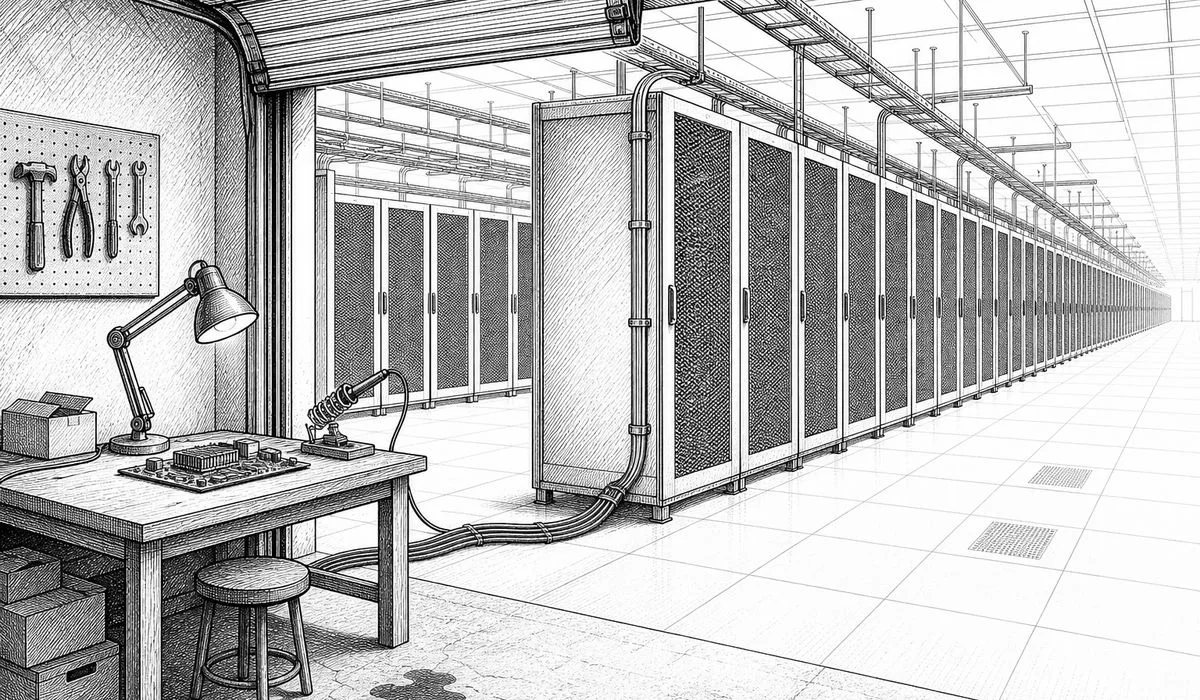
“28 years ago we were a startup company, three people in a garage,” Charles Liang told the trade publication DatacenterDynamics in 2021. The three were Liang, his wife, Sara Liu, and Yih-Shyan Liaw, known as Wally, and the company they incorporated in San Jose in September 1993 was Super Micro Computer. Liang, an electrical engineer trained in Taiwan and Texas, had been president and chief design engineer of Micro Center Computer, a motherboard maker; at Super Micro he became president, chief executive and chairman, and has held all three jobs ever since. Sara Liu, trained in accounting, served as treasurer and chief administrative officer until 2019.
From the start the family’s business reached beyond the company. Its prospectus disclosed that Ablecom, a Taiwan contract manufacturer run by Liang’s brother Steve, was a supplier, and that Charles Liang and Sara Liu together owned about 30.7% of it. It also disclosed something else: in September 2006 the company had agreed to plead guilty to one count of violating federal export regulations, for shipping 300 motherboards to Dubai knowing they would be sent on to Iran. It paid a $150,000 fine and, in a separate settlement with the Treasury’s sanctions office, $179,000.
On Mar 29, 2007, Super Micro sold 6.4 million shares on Nasdaq at $8.00, or $0.80 after the later split. They closed the first day 9.5% higher.
2. Fifteen quiet years
For most of the next decade and a half, Super Micro was the kind of company few investors talked about. It sold servers and the boards and chassis inside them, on thin margins, and it made money: net sales rose from $420 million in fiscal 2007 to $1.45 billion in fiscal 2014, as later adjusted, and the company says it has made a profit every year since it was founded.
Liang’s own preoccupation was electricity. “This commitment started in 2004 while watching the movie, ‘The Day After Tomorrow,’” he later wrote of his decision to make Super Micro’s power supplies and servers more energy-efficient.
The stock was a quieter story. In the financial crisis it fell to $0.385 on Nov 13, 2008, about half the IPO price, its lowest close ever. By December 2014 it had reached $3.65, more than four times the offer price.
3. The first late filing
The first crack appeared in the summer of 2015. On Aug 31 the company told the SEC its annual report would be late while it looked into recently discovered irregularities in certain marketing expenses. In November it corrected the quarterly results it had released in October, because extended-warranty revenue had been booked up front instead of over the life of the warranty.
The larger breakdown came two years later. At 5:18 p.m. ET on Aug 29, 2017, a filing notice told investors that the fiscal 2017 annual report would be late. It would not arrive for almost two years. Only later did the company disclose that an Audit Committee investigation had focused “principally” on “certain revenue recognition matters.” From the close before the notice to a month later, the shares lost 19.5% while the S&P 500 rose.
4. Off the exchange and into the headlines
In January 2018 three senior people left at once: Liaw, the co-founder who ran international sales and sat on the board; the chief financial officer, Howard Hideshima; and Phidias Chou. The company later said Liaw resigned “in connection with a restructuring of the Company’s sales organization as part of the Company’s remediation of material weaknesses.”
Without audited accounts, the pressure built on two fronts. Bank of America, its lender, sent letters extending the deadline for audited statements. Nasdaq’s hearings panel set Aug 24, 2018, as the last day to file. On Aug 20 the company told the panel it could not make it, and trading was suspended “effective at the open of business on August 23.” The shares moved to the over-the-counter market.
Six weeks later, on Oct 4, 2018, Bloomberg Businessweek published “The Big Hack,” reporting that servers Super Micro sold contained malicious microchips and that affected hardware had reached companies including Apple and Amazon. The stock fell 41.1% that day, to $1.26, its worst day as a public company.
The denials came the same day. Super Micro said it “strongly refutes reports that servers it sold to customers contained malicious microchips,” that it had “never found any malicious chips, nor been informed by any customer that such chips have been found,” and that it had “never been contacted by any government agencies either domestic or foreign regarding the alleged claims.” Apple and Amazon issued detailed denials of their own, and British and US security agencies said they had no reason to doubt the companies’ statements. Bloomberg stood by its reporting.
In December Liang wrote to customers that an outside firm had tested the company’s motherboards and “found absolutely no evidence of malicious hardware.” Three years later he was still blunt: “The Bloomberg story is fake news, from our understanding,” he told DatacenterDynamics. No public government finding either way has been located.
The 2018 report: what was reported and what was said
- Reported: Bloomberg Businessweek, Oct 4, 2018: malicious microchips in servers Super Micro sold, with affected hardware reaching companies including Apple and Amazon. Bloomberg stood by its reporting and published a follow-up in February 2021, which Super Micro disputed.
- Super Micro, Oct 4, 2018 (filed with the SEC): it “strongly refutes” the reports; it “has never found any malicious chips”; it “has never been contacted by any government agencies either domestic or foreign regarding the alleged claims.” In December 2018 it told customers an outside review had found no evidence of malicious hardware on its motherboards.
- Apple: said it had never found malicious chips, “hardware manipulations” or planted vulnerabilities in any server. Amazon: its security chief said it had never found “any issues relating to modified hardware or malicious chips” in Super Micro motherboards in its systems.
- Agencies: the UK’s National Cyber Security Centre (Oct 5) and the US Department of Homeland Security (Oct 6) said they had no reason to doubt the companies’ statements.
- The stock: -41.1% on Oct 4, 2018, over the counter; -35.6% from the close before publication to Nov 1, 2018, though +9.4% from the Oct 4 close.
5. The comeback
The repair work was slow. Nasdaq’s appeals ran out, and the stock was formally delisted in March 2019. In May 2019 Super Micro filed its fiscal 2017 annual report, two years late, with restated earlier periods. The investigation, it said, had found that “certain employees had violated our Code of Business Conduct and Ethics,” along with “accounting and financial reporting errors and certain irregularities.” On Dec 19, 2019, about 28 months after the first late notice, the last overdue annual report went in. “Supermicro is a great American success story,” Liang wrote that day.
In January 2020 the shares returned to Nasdaq. “This marks our successful comeback,” Liang said in announcing the relisting. “Not only are we back, but we are stronger, better, and re-energized to capitalize on the opportunities ahead.”
One account remained to be settled. In August 2020 the SEC said Super Micro executives had “pushed employees to maximize end-of-quarter revenue,” and that the company had recognized revenue on goods sent to warehouses but not yet delivered to customers and on misassembled goods, and had used a marketing program to avoid recording other expenses, “including for Christmas gifts.” “Reporting revenue in the wrong period gives investors a distorted view of a company’s financial condition,” said Melissa Hodgman of the SEC’s enforcement division. The company paid a $17.5 million penalty. Liang, who was not charged with misconduct, reimbursed $2.1 million of stock profits under the Sarbanes-Oxley clawback. “We fell short of our standards,” he said.
6. The AI rush
Then the market Super Micro served changed. Companies racing to build artificial intelligence needed servers packed with graphics processors, and Super Micro, which designs and builds much of its own hardware, sold them. Sales rose 46% to $5.20 billion in fiscal 2022 and reached $7.12 billion in fiscal 2023, with the highest annual gross margin since fiscal 2008.
The turn showed up first in the stock on May 3, 2023. The evening before, Super Micro had forecast quarterly sales of $1.7 billion to $1.9 billion, against $1.28 billion in the quarter just ended, and Liang pointed to “record levels of engagements” with customers, “especially for AI applications.” The shares rose 28.3% the next day and more than doubled within a month.
The defining day came in January 2024. After the market closed on Jan 18, the company said quarterly sales would come in at $3.6 billion to $3.65 billion, far above its own guidance of $2.7 billion to $2.9 billion. On Jan 19 the shares jumped 35.9%, the best day in their history, and over the next four weeks they rose another 89.7%. A place in the S&P 500 followed. On Mar 13, 2024, the stock closed at a record $118.81, split-adjusted, about 148 times the IPO price.
Sales and share price since 2007, indexed (fiscal 2007 = 100, log scale)
For 15 years the stock rose more slowly than sales. In fiscal 2023-24 it ran far ahead: by June 2024 the price index stood at about 8,200 against about 3,600 for sales. Since then sales have kept climbing while the price fell back: about 12,800 against about 4,100 in September 2026.
Share price at period-endNet sales (12 months)
Index, fiscal 2007 = 100 (log scale)
Fiscal years end in June. Sales: net sales from the 10-Ks (fiscal 2015-2016 as restated; fiscal 2017 as first filed in 2019; fiscal 2013-2014 as adjusted in 2019); the last point is the 12 months to Sep 30, 2026. Price: the split-adjusted close on the last trading day of each fiscal year (Yahoo Finance, checked against Nasdaq.com from 2016), and Sep 30, 2026.
On Mar 18, its first day in the index, it fell 6.4%. Wally Liaw, absent from the board since 2018, had returned the previous December.
The boom also concentrated the business. The supplier that accounted for 65.4% of Super Micro’s purchases in fiscal 2024, which its filings don’t name, had accounted for 11.4% in fiscal 2022; the annual report says it relies on close relationships with suppliers “including Intel, AMD and NVIDIA,” and lists its AI systems as built on Nvidia platforms.
7. The eight-month fall
Before the August results, the shares had already lost nearly half their March closing value. Then the margins slipped. In early August Super Micro reported a gross margin of 11.2% for the June quarter, as first reported, down from 15.5% three months earlier, and the stock fell 20.1% the next day.
On the morning of Aug 27, Hindenburg Research published a report on the company, disclosing that it had “taken a short position.” Its “3-month investigation,” it said, had “found glaring accounting red flags, evidence of undisclosed related party transactions, sanctions and export control failures, and customer issues.” It quoted a former salesperson on the people who had left after the earlier scandal: “Almost all of them are back.” The stock fell 2.6%.
The next morning, in a filing at 9:07 a.m. ET, Super Micro said its annual report would be late again. The shares fell 19.0%. A week later Liang wrote to customers that “neither of these events affects our products,” and that the short seller’s report “contains false or inaccurate statements about our company.” In September the Wall Street Journal reported an early-stage Justice Department probe, citing people familiar with the matter; neither the company nor the department confirmed it, and the stock fell 12.2%. One by one, the company’s lenders tightened terms: Bank of America required a $250 million prepayment, and Cathay Bank a covenant to keep “at least $150 million of unrestricted cash at all times,” before both facilities were paid off and ended in November.
The auditor had been raising concerns since late July, the company later disclosed, “about several matters relating to governance, transparency and completeness of communications to EY.” On Oct 24 Ernst & Young, in the middle of its audit of the fiscal 2024 accounts, its first for the company, resigned. Its letter became public at 8:51 a.m. ET on Oct 30. “We are resigning,” the firm wrote, “due to information that has recently come to our attention which has led us to no longer be able to rely on management’s and the Audit Committee’s representations and to be unwilling to be associated with the financial statements prepared by management.” The company said it disagreed. The stock fell 32.7%.
On Nov 14, 2024, it closed at $18.01, down 84.8% from the March peak.
Share price vs sales per share, quarterly since 2011 (log scale)
On this log scale, the gap between the lines shows the price-to-sales multiple: a price above the sales line means more than 1 times sales, below it less. Between March and December 2024, the quarter-end price fell from $101.00 to $30.48 while 12-month sales per diluted share rose from $20.26 to $33.10, taking the multiple from 5.0 to 0.9.
Share price at quarter-endSales per share (12 months)
$ per share (log scale)
Sales per share: net sales over the last four quarters divided by the average of their diluted weighted-average share counts. Share counts still on the pre-split basis are multiplied by 10. June-quarter share counts missing from the SEC XBRL data used here are estimated as the average of the March and September quarters either side. Price: the last split-adjusted close on or before each quarter-end.
The recovery began as abruptly. On Nov 18 the company named BDO as its new auditor and sent Nasdaq a plan to regain compliance; the next day the stock rose 31.2%. On Dec 2 a special committee led by Susie Giordano, a former Intel interim general counsel who had joined the board in August to lead it, reported its findings. Independent counsel devoted more than 9,000 hours to the review, which included more than 9 million documents and 68 witness interviews. It looked closely at the rehiring of nine people who had left after the 2017 investigation, found “lapses” in the guardrails around them, but called the decisions to rehire them “the product of reasonable business judgment.” It found “no evidence of misconduct on the part of management or the Board of Directors,” and said EY’s resignation and the conclusions in its letter “were not supported by the facts examined.” The shares rose 28.7%. Among its recommendations was a new chief financial officer.
8. Catching up
Nasdaq’s extension ran to Feb 25, 2025, after which, the company had disclosed, Nasdaq would notify it that its stock would be delisted. On that last day the shares closed down 11.8%. At 4:43 p.m. ET, the overdue annual report, with BDO’s audit opinion, was filed, and Nasdaq confirmed compliance. The stock rose 12.2% the next day.
In February 2025 the company had forecast fiscal 2025 sales of $23.5 billion to $25 billion, “paving the way for $40 billion revenue in FY26”; it would report $21.97 billion for fiscal 2025 and $39.1 billion for fiscal 2026. The rest of 2025 was a run of misses. Preliminary quarterly sales missed guidance in April; in August the fiscal year closed with a fourth-quarter gross margin of 9.5%, and the shares fell 18.3% the next day.
Gross margin by quarter, 2010 to 2026 (%)
From September 2010 through September 2020, quarterly gross margin ranged from 12.0% to 17.3%. It rose to 18.8% in late 2022, fell to 6.3% at the end of 2025, in a quarter when sales more than doubled from the quarter before, and was 17.5% and 12.7% in the last two quarters.
Gross profit as % of net sales
Quarters end in September, December, March and June. Fourth quarters use reported three-month figures where available; otherwise net sales and gross profit are each the fiscal year minus the first nine months. Amounts are the latest filed facts for each period in SEC XBRL.
Another preliminary miss in October, about $5 billion against guidance of $6 billion to $7 billion, coincided with an 8.7% fall.
9. A co-founder in court
On Mar 19, 2026, federal prosecutors in Manhattan announced charges against three people. Wally Liaw, the co-founder, by then a senior vice president and again a director, was arrested and brought before a federal court in Northern California, as was Ting-Wei Sun, whom the company described as a contractor; a sales manager in the company’s Taiwan office, prosecutors said, “remains a fugitive.” The charges included conspiring to violate US export controls by diverting servers with US artificial intelligence technology to China.
The Justice Department’s account, which remains a set of allegations, did not name the company; it referred to “the U.S. Manufacturer.” It alleged that, at the defendants’ direction, a Southeast Asian company bought “approximately $2.5 billion worth of servers” in 2024 and 2025, that “at least approximately $510 million” worth were diverted to China in a few weeks of 2025, and that the defendants staged “thousands of ‘dummy’ servers” to deceive the manufacturer’s own compliance team, including for an audit the manufacturer conducted in August 2025. Before a later Commerce Department inspection, prosecutors said, Sun and a broker were caught on surveillance cameras using “a hair dryer to remove and affix labels and serial number stickers.” US Attorney Jay Clayton described “a tangled web of lies, obfuscation, and concealment.” Liaw pleaded not guilty, Bloomberg reported.
Super Micro said that day that it was “not named as a defendant,” that it had put the two employees on leave and ended the contractor’s relationship, and that it “has been cooperating fully with the government’s investigation.” The next day the stock fell 33.3%, to $20.53, and Liaw resigned from the board.
What followed was the company’s two stories running at once. In May it reported quarterly sales of $10.2 billion, and the shares rose 24.5%. After the close on Jun 9 it announced a stock and preferred-share offering “to fund the purchase of components to satisfy the approximately $39 billion of orders” received from more than 20 customers in recent weeks, orders that its own filings warned were not firm commitments. The offerings raised about $5.75 billion before costs, including the underwriters’ options: cash to buy components, at the price of new shares now and more when the preferred converts. The stock fell 28.0% on the first trading day after the plan became public, and the new common shares were priced at $27.50. In July the company estimated a preliminary gross margin of 15-17% and reported more than $60 billion of new orders in the quarter, some of which, it warned, might not be firm commitments; the shares rose 19.8% the next day.
Growth and repair went on alongside the criminal case. A board-led investigation reported in August that it “did not find any evidence that any current member of senior management had knowledge of the alleged diversion scheme,” and the company said it had dismissed staff in sales, technical support and business development. Fiscal 2026 sales reached $39.1 billion, about 93 times those of fiscal 2007. Mark Long, formerly Western Digital’s finance chief, became chief financial officer in October, nearly two years after the special committee recommended a change. In November the company reported record quarterly sales of $19.9 billion, almost four times the year before, and forecast $72 billion to $82 billion for the fiscal year. The company that began with three people reported more than 7,000 employees at the end of June 2026, over 3,200 of them in San Jose.
Nine days later came the reports of further federal inquiries, and the 11.3% fall.
What the past suggests to watch
Super Micro’s history doesn’t predict its next chapter, but it shows where the turns have come from.
- Filing deadlines: the company disclosed late annual reports in August 2017 and August 2024, at the start of its two accounting crises. The next quarterly report is due in early February 2027.
- Auditors and controls: an auditor’s departure or a finding of weak internal controls came before both crises.
- Margins against guidance: gross-margin surprises arrived with some of the biggest results-day moves, down 20.1% in August 2024 and up 19.8% in July 2026, though other news came out at the same time.
- Press reports against official action: in September 2024 and again on Nov 12, 2026, the stock fell on press reports before any official confirmation. The criminal case, the SEC investigation and other inquiries disclosed in the annual report remain open; the company says the Commerce Department’s export-enforcement inquiries are too preliminary to estimate a possible loss.
- New shares: the 7.00% mandatory convertible preferred sold in June converts into about 130.7 million to 156.8 million common shares in 2029, unless converted earlier and subject to adjustments, and an at-the-market program allows up to $1.25 billion more.
Charles Liang, chief executive since 1993, is still chairman and chief executive; the company’s proxy reported that he and Sara Liu beneficially owned 13.4% of it as of Jan 31, 2026, including options and restricted stock units they could acquire within 60 days. The record shows a company that has twice been knocked down by questions about its books and controls and twice come back to growth. It doesn’t show how the questions in front of it now will be answered.
The story in figures: turning points and the stock's reaction
| Date the news could trade | Turning point | Stock that day | S&P 500 that day | Stock, prior close to 20 sessions later |
|---|---|---|---|---|
| Mar 29, 2007 | IPO at $8.00 ($0.80 split-adjusted) | +9.5% vs offer | – | +27.5% |
| Aug 30, 2017 | Fiscal 2017 annual report late | -5.0% | +0.5% | -19.5% |
| Oct 4, 2018 | Bloomberg Businessweek “The Big Hack” | -41.1% | -0.8% | -35.6% |
| Jan 14, 2020 | Relisted on Nasdaq | -5.3% (Nasdaq close; Yahoo -2.8%) | -0.2% | +1.9% |
| May 3, 2023 | AI-driven guidance | +28.3% | -0.7% | +121.2% |
| Jan 19, 2024 | Sales far above guidance | +35.9% | +1.2% | +157.9% |
| Aug 7, 2024 | Gross margin 11.2% vs 15.5% | -20.1% | -0.8% | -32.8% |
| Aug 28, 2024 | Annual report late | -19.0% | -0.6% | -26.5% |
| Oct 30, 2024 | Ernst & Young’s resignation disclosed | -32.7% | -0.3% | -28.6% |
| Nov 19, 2024 | BDO hired; Nasdaq plan | +31.2% | +0.4% | +49.6% |
| Dec 2, 2024 | Special committee: no evidence of misconduct | +28.7% | +0.2% | -6.6% |
| Feb 26, 2025 | Filings current again | +12.2% | 0.0% | -18.7% |
| Mar 20, 2026 | Indictment unsealed | -33.3% | -1.5% | -6.4% |
| Jun 10, 2026 | Proposed share and preferred offering | -28.0% | -1.6% | -30.3% |
| Jul 22, 2026 | Margin 15-17%; orders above $60B | +19.8% | -0.1% | +43.5% |
| Nov 12, 2026 | Reports of further federal inquiries | -11.3% | -0.4% | – |
- Our calculation from Yahoo Finance split-adjusted closes: 4,939 daily closes from Mar 29, 2007 to Nov 12, 2026 (1,025 weekly closes in the chart). Across 4,938 daily moves the average was +0.15%; the best was +35.9% (Jan 19, 2024) and the worst -41.1% (Oct 4, 2018). The table shows 16 selected turning points from the research’s 47; it is not a complete list. The 20-session column runs from the close before the news, so it includes the first day’s move. A filing accepted after 4 p.m. ET is matched to the next session; one accepted before the open, to the same day. Each window can contain more than one piece of news, so the price can’t isolate a single cause.
- Price path: IPO $8.00 ($0.80 split-adjusted); low $0.385 on Nov 13, 2008; record $118.81 on Mar 13, 2024; low after the auditor crisis $18.01 on Nov 14, 2024 (-84.8%); 2026 low $20.53 on Mar 20 and high $50.17 on Jun 2; $26.99 on Nov 12, 2026. At the Nov 12, 2026 close, SMCI stood at 33.7 times its split-adjusted IPO price; the S&P 500 stood at 5.3 times its Mar 29, 2007 close (price only, dividends excluded).
| Fiscal year (to June) | Net sales | Gross margin | Net income |
|---|---|---|---|
| 2007 | $420M | 17.8% | $19M |
| 2014 (as adjusted in 2019) | $1.45B | 15.1% | $48M |
| 2017 (filed in 2019) | $2.48B | 14.1% | $67M |
| 2019 | $3.50B | 14.2% | $72M |
| 2021 | $3.56B | 15.0% | $112M |
| 2022 | $5.20B | 15.4% | $285M |
| 2023 | $7.12B | 18.0% | $640M |
| 2024 | $14.99B | 13.8% | $1,153M |
| 2025 | $21.97B | 11.1% | $1,049M |
| 2026 | $39.1B | 10.8% | $2,230M |
| Jul-Sep 2026 (one quarter) | $19.9B | 12.7% | $1,594M |
- Company 10-Ks and results releases; 10 of 20 fiscal years (FY2007-FY2026) shown, plus one quarter; fiscal 2014 uses the adjusted figures disclosed in 2019.
- Concentration (fiscal 2026 10-K): one customer, not named, was 28.1% of sales; the largest supplier, not named, was 63.1% of purchases. Related parties Ablecom and its affiliate Compuware were 2.1% of cost of sales.
- Cash and financing: operating cash flow was -$6.81 billion in fiscal 2026. At Sep 30, 2026, cash was $6.9 billion against $8.6 billion of bank debt and convertible notes. In June 2026 the company sold 52.3 million common shares at $27.50 and 86.25 million depositary shares of 7.00% mandatory convertible preferred; the preferred converts into about 130.7 million to 156.8 million common shares (our calculation from the stated conversion rates).
What to watch next
- Early Feb 2027
- The next quarterly report (10-Q) is due. The company disclosed late annual reports in August 2017 and August 2024, at the start of its two accounting crises.
- Not dated
- The criminal case against co-founder Wally Liaw (not guilty plea), the SEC investigation and other government inquiries disclosed in the 10-K; the company is not a defendant.
- Not dated
- Whether the fiscal 2027 sales outlook of $72 billion to $82 billion holds, whether gross margins stay within the last two quarters' 12.7-17.5% range, and how many new shares the mandatory convertible preferred adds.
Quick questions
Why did Super Micro stock fall so much in 2024?
After peaking at $118.81 (split-adjusted) on Mar 13, 2024, the stock fell 84.8% to $18.01 by Nov 14. The fall came with a drop in gross margin, a short seller's report, a delayed annual report and, on Oct 30, the disclosure that its auditor, Ernst & Young, had resigned, saying it could no longer rely on management's and the Audit Committee's representations. A special committee later found no evidence of misconduct by management or the board.
Was Super Micro charged in the 2026 export case?
No. In March 2026 federal prosecutors in New York charged three people, including co-founder and director Wally Liaw, with conspiring to violate export controls; Liaw pleaded not guilty. Super Micro said it was not named as a defendant, and a board-led investigation reported in August 2026 that it found no evidence that any current member of senior management knew of the alleged scheme.
What was the 2018 Bloomberg 'Big Hack' report?
Bloomberg Businessweek reported on Oct 4, 2018 that servers Super Micro sold contained malicious microchips. Super Micro, Apple and Amazon denied it that day, Bloomberg stood by its reporting, and no public government finding either way has been located. The stock fell 41.1% that day.
About Super Micro Computer: Website (external site)Investor relations (external site)SEC filings (external site)Wikipedia (external site)
+ 28 more
Accessed Nov 12, 2026: Super Micro Computer: IPO prospectus (424B4), Mar 2007 · Super Micro Computer: Form 10-K for fiscal 2017, filed May 2019 (restatement and investigation findings) · Super Micro Computer: statement refuting the Bloomberg Businessweek article, Oct 4, 2018 (8-K exhibit) · Apple: What Businessweek got wrong about Apple, Oct 2018 · Super Micro Computer: Nasdaq relisting approved, Jan 9, 2020 (8-K exhibit) · Super Micro Computer: SEC settlement, Aug 25, 2020 (8-K) · Super Micro Computer: special committee completes its review, Dec 2, 2024 (8-K exhibit) · Super Micro Computer: statement on the action by the US Attorney's Office, Mar 19, 2026 (8-K exhibit) · Super Micro Computer: proposed offerings, Jun 9, 2026 (8-K exhibit) · Super Micro Computer: preliminary fourth-quarter fiscal 2026 business update, Jul 21, 2026 (8-K exhibit) · Super Micro Computer: mandatory convertible preferred terms, Jun 15, 2026 (8-K) · Super Micro Computer: chief financial officer appointment, Oct 2026 (8-K) · Bloomberg Law: Super Micro co-founder pleads not guilty, Apr 2026 · Super Micro Computer: completion of the independent investigation, Aug 20, 2026 · Super Micro Computer: first-quarter fiscal 2027 results, Nov 3, 2026 (8-K exhibit) · Our calculation: Yahoo Finance split-adjusted daily closes for SMCI and the S&P 500, Mar 2007 to Nov 12, 2026, checked against Nasdaq.com from Nov 2016
Accessed Nov 13, 2026: DatacenterDynamics: 28 years later: Supermicro's wild ride (interview with Charles Liang), Aug 2021 · Supermicro: Charles Liang's 30th-anniversary open letter · Super Micro Computer: 2026 proxy statement (directors, executive officers, ownership) · Super Micro Computer: letter to customers on motherboard testing, Dec 2018 (8-K exhibit) · Super Micro Computer: letter on becoming current with filings, Dec 19, 2019 (8-K exhibit) · SEC: Super Micro Computer and former CFO charged with accounting violations, Aug 25, 2020 (release 2020-190) · Hindenburg Research: report on Super Micro, Aug 27, 2024 (disclosed a short position) · Super Micro Computer: Charles Liang's letter to customers and partners, Sep 3, 2024 (8-K exhibit) · Super Micro Computer: third-quarter fiscal 2023 results, May 2, 2023 (8-K exhibit) · Super Micro Computer: preliminary second-quarter fiscal 2025 update and outlook, Feb 11, 2025 (8-K exhibit) · Super Micro Computer: Form 10-K for fiscal 2024, including the credit-facility amendments · Wall Street Journal: Justice Department probes server maker Super Micro Computer, Sep 26, 2024
Quoting this? You may quote short excerpts under our reuse policy. Please credit WhyMyStockMoved.com and link to this page.