The $6 billion test: what crypto is for, and where it could go from here
What is crypto actually used for, and where could it go from here?
Bitcoin today is a volatile, scarce asset that people mostly hold, including through funds and companies, rather than the everyday cash it set out to be, while stablecoins, tokens designed to track a currency, are where real use is growing, from a small base. Where it goes from here depends on four things we track with signposts, not price forecasts: whether stablecoins become ordinary plumbing, whether bitcoin keeps its buyers, whether the old boom-and-bust cycle repeats, and whether trust survives shocks such as the record theft at Binance.
Twenty minutes on a Thursday
Shortly after 4 p.m. Eastern on Oct. 29, money started leaving Binance, the world’s biggest crypto exchange. Tracing firms watched it drain from the company’s internet-connected wallets across several blockchains, and Reuters reported that the bulk of it went in about 20 minutes. More than $6 billion was gone. “This incident is almost certainly the single-largest-known theft of any kind,” said Elliptic, a British blockchain analysis firm, in Reuters’ account. The FBI blamed a North Korean state-backed unit it calls TraderTraitor, NBC News reported.
What happened next is the more telling part. Within about an hour, the first freezes began, Chainalysis said. Tether and Circle, the companies behind the two largest dollar tokens, locked the tokens the thief held, Reuters reported: nearly $1.57 billion at Tether and more than $800 million at Circle. The bitcoin and ether could not be frozen that way. Binance said it would cover the losses from its own money. “Our users will not bear the financial impact of this incident,” its co-chief executive, Richard Teng, wrote on X, NBC reported. Abu Dhabi’s financial regulator, which issued Binance’s main licence, said it was “engaging closely with Binance and monitoring the incident.” Bitcoin slipped to a six-week low and steadied.
Bitcoin’s founding paper promised something else: payments sent “directly from one party to another without going through a financial institution.” Eighteen years on, crypto’s largest crisis of the year is being handled by a corporate balance sheet and a few token issuers, with a regulator and, Reuters reported, US bank supervisors looking on. The consequences are still unfolding. That, in our reading, is where crypto now stands. It hasn’t replaced the financial system. It has become a volatile, growing and contested part of it, worth about $2.57 trillion in all, according to CoinGecko, with bitcoin 39% below its record close of October 2025 while the S&P 500 is 9% above where it stood that day.
So what is it for, who runs it, and where does it go? We start with the last question, because it’s the one investors ask. We don’t predict prices.
The theft: what's known and what isn't
Timing: TRM Labs dates the start to 20:05 UTC (4:05 p.m. ET) with a second wave around 23:05 UTC; Chainalysis says funds began leaving “around 4:20 p.m. ET.”
Size: TRM: about $6.36 billion at the time taken. Chainalysis: about $6.4 billion. Reuters and NBC: $6.3 billion. The FBI’s notice: more than $6 billion.
Method: Teng first described a “complex attack” with a compromised laptop and software designed to delete evidence (Reuters). Binance later said the attack began months earlier and combined fake recruitment interviews with malicious downloads and a flaw in an internal AI tool, ITPro reported on Nov 5. That is the company’s account.
Frozen: About $2.8 billion as of 11:30 a.m. ET on Nov 3, per Chainalysis.
Covered: Binance said it set aside about $6.34 billion of company funds (NBC), and on Nov 4 that it had replenished about 98% of the stolen assets (Binance announcement). It was still reopening withdrawals in stages on Nov 5. Its co-chief executive Yi He said $3 billion was about 2% of user assets and public reserves (Reuters).
Attribution: North Korea denies using state-linked units for theft, Reuters reported.
Scale: Chainalysis counts over $3.4 billion stolen across all of crypto from January to early December 2025; TRM Labs counts $2.9 billion for 2025 (Reuters). The two firms measure differently.
Supervisors: Fed and OCC supervisors “started reaching out to banks” to ask about “unusual activity or disruption,” Reuters reported on Nov 5, citing several sources; one bank said it had no disruptions. The Fed and OCC did not comment.
Not confirmed by us: Binance announced a reserve snapshot on Oct 31 and a wider one on Nov 4. We haven’t tested them, and they aren’t a full audit of its assets and liabilities. We also haven’t confirmed that withdrawals are back on every network. Bitcoin was $75,867 at the Nov 6 close (Yahoo Finance, which uses a midnight UTC close for bitcoin).
Four paths from here
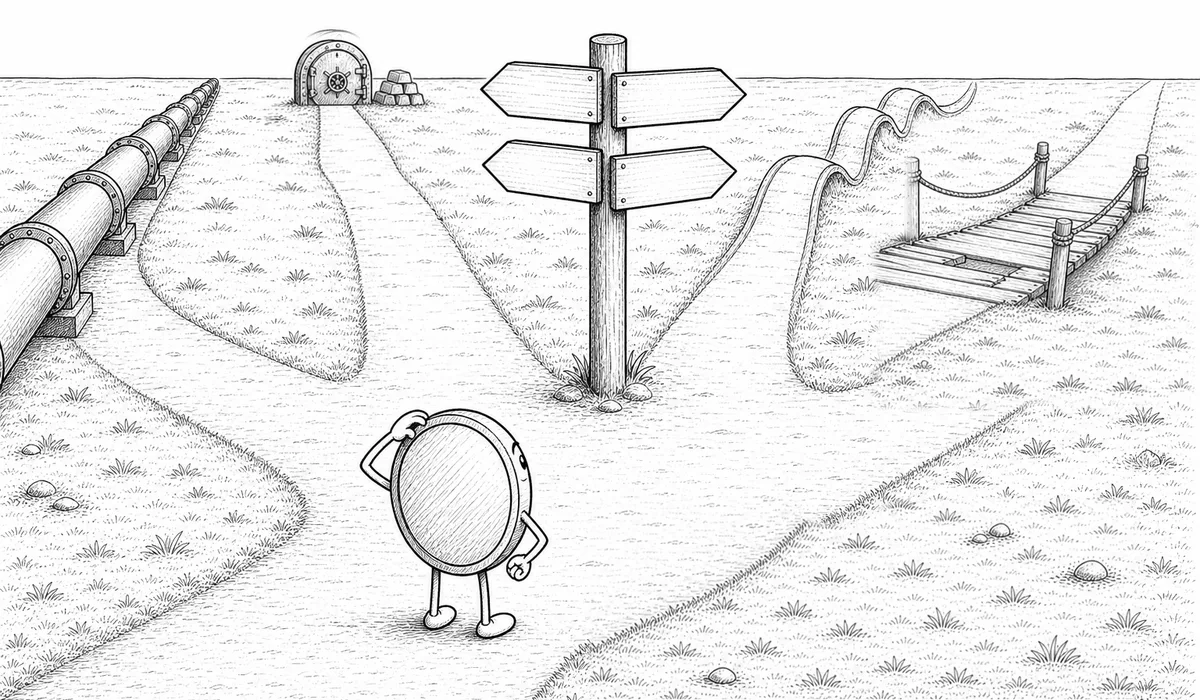
Confident numbers exist on every side of crypto, and they have often been wrong. What can be tracked is which of four paths it’s on. These paths are our own framework, built from other people’s arguments. They can overlap, and we give them no prices and no odds.
The first is plumbing. Here, stablecoins and tokens become ordinary pipes for payments and markets, and the winners may be banks and payment firms rather than token holders. Larry Fink, BlackRock’s chief executive, describes tokenization in his 2026 letter as “recording ownership on digital ledgers to reduce friction, lower costs, and speed settlement,” while noting that new financial rails “don’t depend on any single technology.” Jamie Dimon, JPMorgan’s chief executive, has called bitcoin a “fraud” and a “pet rock.” He wrote to shareholders this year that “a whole new set of competitors is emerging based on blockchain.” His response: “We need to roll out our own blockchain technology,” Fortune reported. This path doesn’t require bitcoin to rise at all.
The second is digital gold: bitcoin held as a scarce reserve as governments struggle with debt. Bernstein’s analysts argue that rising borrowing costs and government debt strengthen the case for assets that can’t be diluted, The Block reported. Citi’s 12-month forecast rests on something smaller and easier to check, a return of buying through exchange-traded funds (ETFs) as advisers slowly add bitcoin, Reuters reported. The view of Warren Buffett, the investor, stands at the other pole. In 2018, when bitcoin was near $9,858, he called it “probably rat poison squared,” CNBC reported, and said cryptocurrencies would “come to a bad ending.” Bitcoin has risen since. His claim was about what it is, and that argument isn’t settled by a price.
The third is the old cycle. Our price data, which starts in 2014, shows 5 falls of at least half. Four began at record closes, and three of those were later followed by a new record; the latest hasn’t been so far. Bernstein’s own central case tracks a four-year rhythm. What’s different this time is who might have to sell. Strategy, the company that made a business of holding bitcoin, reports an average cost of $75,451 a coin in its November filing, almost exactly the current price, and it has started selling small amounts to help fund dividends and buybacks.
The fourth is a break in trust. Binance was one kind of shock. Others would be a dollar token that can’t meet redemptions, a government turning hostile, or a machine that can break bitcoin’s signatures, a risk Google’s researchers took seriously enough to estimate in March. Hyun Song Shin, now governor of the Bank of Korea, argued in a March working paper for the Bank for International Settlements (BIS), the central banks’ own bank, that the flaw is structural: money depends on network effects, while open blockchains reward fragmentation. Matt Hougan, chief investment officer at Bitwise, an asset manager that sells crypto funds, gave the other side after Binance. “Looking at all past data, we find that hot wallet hacks — even large ones — have historically not had a meaningful impact on future crypto returns,” he said, according to Reuters.
The four paths: what would have to be true, and what would show it
| Path | What would have to be true | Signposts | Who argues it; who disputes it |
|---|---|---|---|
| Plumbing | Payments, not trading, drive growth; rules let banks and issuers compete; costs beat existing rails after all fees | McKinsey/Artemis’s payments estimate ($390B a year in its first reading) grows by multiples; stablecoin supply passes its May 2026 high of $316B; issuers apply under GENIUS after Jan 18, 2027; tokenized assets distributed to holders ($39.4B) keep rising | For: Fink, Bessent, Citi on stablecoins. Against: the BIS, which says the main use “so far” has been crypto trading and favours tokens tied to central banks and commercial banks |
| Digital gold | Buyers hold through falls; bitcoin moves less like tech stocks; large holders don’t have to sell | ETF net flows against Citi’s assumed $5B over 12 months; bitcoin’s correlation with the Nasdaq (0.48) and gold (0.31); any government buying beyond seized coins; a final Labor Department rule on 401(k) plans | For: Bernstein, Standard Chartered, ARK Invest. Against: Buffett; Gary Gensler in 2024 (“primarily a speculative, volatile asset”) |
| Old cycle | Prices still follow supply and leverage; records follow busts | Liquidation totals; miners’ costs against the price; Strategy’s bitcoin sales and its share price against the value of its bitcoin; trading volume at Coinbase | For: Bernstein’s base case. Against: those who say ETFs and treasuries damp the swings, a point Bernstein also makes about this fall |
| Break in trust | A shock too large for private balance sheets; or law turns hostile; or the technology fails | Binance’s reserve proof and any regulator’s action; Tether’s buffer ($7.96B at Sept 30); status of BIP 360, now a draft; what the new Congress does with CLARITY | For: Shin, the BIS. Against: Hougan; Michael Saylor, Strategy’s executive chairman, who wrote that the industry will “emerge stronger and more resilient” (Reuters); Adam Back, Blockstream co-founder, who says quantum risk isn’t imminent (Bloomberg) |
Quantum: Google’s March paper models the resources a future quantum computer would need to break bitcoin’s cryptography. No such machine has been demonstrated. BIP 360, a proposed change to bitcoin’s transaction rules, remains a draft, not an activated protection.
Named forecasts, theirs not ours, with their record
| Who | Dated call | Basis, as reported | Earlier calls and outcome |
|---|---|---|---|
| Citi (Sept 30 note, Reuters) | $113,000 in 12 months | ETF inflows of $5B over 12 months; supportive macro | Started 2026 at $143,000; cut to $82,000 in July (24/7 Wall St.). All were revised before they came due |
| Standard Chartered, Geoff Kendrick, its global head of digital asset research (Aug 19) | $100,000 by end-2026; on Aug 21 he said that might be too low, Cointelegraph reported | Treasury buybacks and liquidity | End-2025 target cut to $100,000 from $200,000 on Dec 9, 2025 (The Block). Bitcoin ended 2025 at $87,509, below both. End-2026 target cut to $100,000 from $150,000 in February (Bloomberg headline) |
| Bernstein, led by analyst Gautam Chhugani (Aug 26) | About $125,000 by end-2026; $150,000 by mid-2027; about $1M by end-2033 | Four-year cycle, production cost, debt | $200,000 by end-2025, called “conservative” in October 2024 (The Block): missed |
| ARK Invest, led by chief executive Cathie Wood (Big Ideas 2026, The Block, January) | About $16T of bitcoin market value by 2030, about $761,900 a coin on 21M coins | Store of value, institutions, ETFs and company holdings | Deadline ahead. A May report by Barchart gives $1.25M a coin, which doesn’t match that market value |
Reports differ on when Bernstein cut: The Block has $125,000 on Aug 26, 24/7 Wall St. on Oct 5. These are what these houses said; we didn’t read the notes themselves.
Our arithmetic, not a forecast: what the big stablecoin numbers would take
Stablecoin supply is about $294B (DefiLlama, Nov 6). US Treasury Secretary Scott Bessent said in November 2025 that the market, then around $300B, “could grow tenfold by the end of the decade” (Treasury). That is about $3T. Citi’s September 2025 base case is $1.9T by 2030 and its bull case $4T (Yahoo Finance). From today to the end of 2030, $3T needs growth of about 75% a year and $1.9T about 57%. Supply grew about 19% a year over the past four years, from $145B in November 2022. At that pace it would reach about $609B by the end of 2030. Formula: (target ÷ today)^(1 ÷ 4.15 years) − 1. This shows the size of the claim; it says nothing about which number is right.
From electronic cash to ‘digital gold’
Crypto didn’t set out to be an asset class. The 2008 paper by Satoshi Nakamoto, a pseudonym, is titled “A Peer-to-Peer Electronic Cash System.” The name changed as the use did. By December 2024 the chair of the Federal Reserve was describing something quite different. “People use bitcoin as a speculative asset, right? It’s like gold,” Jerome Powell said at a New York Times conference, The Block reported. “It’s not a competitor for the dollar.”
The institutions followed. When the SEC cleared the first US spot bitcoin ETFs in January 2024, its chair, Gary Gensler, called bitcoin “primarily a speculative, volatile asset” and added, “we did not approve or endorse bitcoin.” Larry Fink, whose firm’s fund became the largest, said that summer that it was “a legitimate financial instrument,” The Block reported, and admitted “I was a proud skeptic.” In March 2025 a White House order creating a Strategic Bitcoin Reserve wrote the comparison into policy, noting that bitcoin “is often referred to as ‘digital gold’.” A year later the SEC sorted tokens into categories that include “digital commodities.”
Whether the label fits is another matter. Over the past year bitcoin’s daily moves have tracked the Nasdaq more closely than gold. Since its record it has fallen 39%, while a gold fund has gained 2%. Governments have tested the other idea, money for daily use, and the best-known test ended quietly: El Salvador made bitcoin legal tender in 2021 then made acceptance by businesses voluntary in 2025, The Rio Times reported, and the IMF said in September that the government’s e-wallet had passed to a private operator.
Key dates only
| Date | What happened |
|---|---|
| Oct 2008 | Nakamoto’s paper; the network starts in January 2009 |
| 2014, 2018 | Tether’s first dollar token; USDC follows (Wikipedia) |
| July 2015 | Ethereum launches, adding programs that run on a blockchain (Ethereum.org) |
| Dec 2017 | Token-sale boom; bitcoin’s record close of $19,497, then a fall of 83% over a year |
| Nov 2021 | Record close of $67,567 after a year when Coinbase listed in the US |
| May 2022 | TerraUSD loses its peg; the SEC says about $40B in market value was wiped out “almost overnight” |
| Nov 2022 | FTX collapses; Sam Bankman-Fried is later sentenced to 25 years for stealing billions of dollars from customers (Financial Planning) |
| Jan 2024 | First US spot bitcoin ETFs |
| July 2025 | GENIUS Act signed |
| Oct 2025 | Record close of $124,753 on Oct 6; about $19B of leveraged bets liquidated on Oct 10, according to CoinGlass, as reported by CryptoSlate |
| June 2026 | Low close of $58,559 on June 30 |
| Oct 2026 | Binance theft |
Bitcoin's falls of at least 50% from a running high, Sept 2014 to Nov 6, 2026 (%)
Five falls of at least half in 12 years. The low of the latest so far, −53%, is level with the shallowest of the five, and there's been no new record since.
Show the data table
| Fall | Starting high | Low close | Fall (%) | Days from record to low |
|---|---|---|---|---|
| Sep 2014–Jan 2015 | $457 | $178 | -61 | 119 |
| Dec 2017–Dec 2018 | $19,497 | $3,237 | -83 | 364 |
| Apr 2021–Jul 2021 | $63,503 | $29,807 | -53 | 98 |
| Nov 2021–Nov 2022 | $67,567 | $15,787 | -77 | 378 |
| Oct 2025–Jun 2026 | $124,753 | $58,559 | -53 | 267 |
Bitcoin against gold: the size test
Size is the comparison bitcoin’s backers reach for first, and it depends on which gold you count. The World Gold Council puts all gold above ground at about 224,200 tonnes, worth about $30.0 trillion at the end of September. Bitcoin, at about $1.52 trillion on Nov. 6, is about 5% of that, and all of crypto about 9%. But nearly half of that gold is jewellery. Count only investment gold, and bitcoin rises to 11%. Leave out central banks as well, keeping bars, coins, funds and over-the-counter holdings, and it is 18%, with all of crypto at 30%, by our arithmetic.
Is it a fair comparison? Only partly. Jewellery and central banks give gold buyers that bitcoin doesn’t have, and gold has been held for thousands of years, against about 17 for bitcoin. Bitcoin’s headline value also counts coins nobody can spend: estimates of lost coins run from 2.3 million to 3.7 million, roughly a tenth to a sixth of those that will ever exist, as reported by the wallet maker Ledger. And the price that sets each value is made by a small share of the total changing hands. Both have been volatile lately, gold included, but bitcoin’s swings over the past year were about half as large again.
Gold and crypto by value ($ trillions): gold at end-Sept 2026, crypto on Nov 6, 2026
Bitcoin is about 5% of all gold and about 18% of private investment gold. The answer depends on which gold you count.
GoldCrypto
Show the data table
| Measure | $ trillions |
|---|---|
| All above-ground gold | 30.0 |
| Investment gold, with central banks | 14.0 |
| Investment gold, private only | 8.5 |
| All crypto | 2.57 |
| Bitcoin | 1.52 |
| Bitcoin without lost coins (high est.) | 1.24 |
The comparison, and why it isn't like for like
| Comparison | Bitcoin | All crypto |
|---|---|---|
| All above-ground gold, $30.0T | 5% | 9% |
| Investment gold with central banks, $14.0T | 11% | 18% |
| Private investment gold, $8.5T | 18% | 30% |
World Gold Council, end-Q3 2026: jewellery about 98,700 tonnes, $13.5T; central banks about 39,300 tonnes, $5.5T; bars and coins about 48,100 tonnes, $6.5T; gold ETFs about 4,300 tonnes, $0.5T; over-the-counter about 10,000 tonnes, $1.5T; other about 23,800 tonnes, $3.0T. Its “physical investment gold” of about $14.0T combines central banks, bars, coins, ETFs and over-the-counter.
Dates differ. At the Nov 6 gold futures settlement of about $4,080 an ounce, all above-ground gold would be about $29.4T (our arithmetic).
All crypto includes about $294B of stablecoins, which are dollars in token form, not a store-of-value bet.
Lost coins: 2.3M to 3.7M is attributed to Chainalysis in Ledger’s account, which leaves $1.24T to $1.35T on 20.1M coins at the Nov 6 price (our arithmetic). No one can identify lost coins for certain, and wider “dormant” counts are not the same thing.
Free float: ETFs hold about 6.4% of bitcoin’s value, and Strategy about 4.0% of the 21M cap, which narrows what trades. Gold has its own version, as most jewellery rarely comes to market.
Volatility: annualised standard deviation of daily returns over the 251 trading days to Nov 6 was about 44% for bitcoin and 29% for a gold fund (GLD), our calculation. One year only, and an unusually rough one for gold.
Who would buy bitcoin next depends mostly on policy, and the rules are often described wrongly. We found no general requirement that funds hold a low single-digit share in alternative investments. Allocations are mostly choices that boards make, and they vary widely. University endowments held 54% in alternatives on a dollar-weighted basis in fiscal 2025, the NACUBO-Commonfund study found, while Japan’s giant GPIF pension fund held 1.70% against a 5% ceiling. Those alternatives are mainly private equity, hedge funds and real assets, and crypto isn’t named in NACUBO’s definition. Low single digits is where crypto advice sits instead, as suggestions rather than rules: Bank of America suggests 1% to 4% for suitable clients, The Block reported, and BlackRock has argued for 1% to 2%. In the US, a Labor Department proposal would ease the way for 401(k) plans to consider crypto; it doesn’t require anyone to buy, and we found no final rule. Buyers also leave: Harvard cut its bitcoin ETF stake by more than half in the six months to March, The Block reported, while Abu Dhabi’s Mubadala kept its stake through June.
Who holds alternatives, what's required, and what it would mean for bitcoin
Pensions: in the seven largest markets, the average allocation was 48% equities, 31% bonds, 19% other and 3% cash at the end of 2025 (Thinking Ahead Institute). “Other” isn’t only alternatives, and the study’s public summary gives no crypto figure.
Endowments: 54.1% dollar-weighted and 29.9% equal-weighted in “alternative and other strategies,” with larger funds higher (NACUBO-Commonfund, FY2025, as of June 30, 2025). Its list covers hedge funds, private equity, venture capital and real assets, among others.
Closest thing to a mandate: 17 UK pension providers agreed voluntarily to put at least 10% of default funds into private markets by 2030, half of that in the UK. The UK minister said a reserve power would only “backstop” those goals (IPE, March 2026). That’s private markets, so it wouldn’t apply to bitcoin held through an ETF. We haven’t confirmed the final wording of the law. GPIF’s 5% is a ceiling, not a floor; Japan’s government wants it to do more, Nikkei reported.
Crypto now: Bitwise, which sells crypto funds, interviewed 15 institutions in 2026: 0.5% to 13% of investable assets, most at 1% to 2%. It chose institutions that already hold crypto, so this isn’t an average for all funds.
Named suggestions, all voluntary: Morgan Stanley’s investment committee caps crypto at up to 4% for high-growth portfolios and 2% for balanced ones, with none for wealth preservation and income (CoinMarketCap Academy; The Block dates it to October 2025). Bank of America: 1% to 4% (The Block, December 2025). BlackRock: 1% to 2% (its 2024 paper). Fidelity: 2% to 5%, higher for younger investors (Yellow Research, citing Fidelity). JPMorgan’s private bank calls it a “satellite” holding for aggressive investors (same source).
US retirement accounts: Executive Order 14330 (August 2025) led to a Labor Department proposal on March 30, 2026. Comments closed June 1, and the rule would apply to fiduciaries choosing plan menus. “The department’s days of picking winners and losers are over,” said Keith Sonderling, deputy labor secretary, per The Block. Senator Elizabeth Warren criticised putting “these risky assets” in 401(k)s.
Who can’t or won’t buy: mainland Chinese investors, under Notice 42; any fund whose own policy excludes it; Morgan Stanley’s wealth-preservation and income portfolios. Japan’s law starts in 2027, and spot bitcoin ETFs aren’t yet allowed there, Bitcoin.com News reported in July. Harvard: 6.81M IBIT shares at Sept 30, 2025, 3.04M at June 30, 2026. Mubadala: 14.7M shares, unchanged in Q2 (The Block).
Our arithmetic, not a forecast. It assumes all of it goes to bitcoin, at about $1.52T of value and about 164,250 new coins a year (3.125 per block), worth about $12.4B at the Nov 6 price:
| Pool | Size | 0.1% | 0.5% | 1% | In years of new coins | As a share of bitcoin’s value |
|---|---|---|---|---|---|---|
| Global pension assets (22 markets), end-2025 | $68.3T | $68B | $341B | $683B | 5.5 to 55 years | 4.5% to 45% |
| US 401(k) plans, June 30, 2026 | $10.8T | $11B | $54B | $108B | 0.9 to 9 years | 0.7% to 7% |
| US IRAs, June 30, 2026 | $19.9T | $20B | $99B | $199B | 1.6 to 16 years | 1.3% to 13% |
| Assets run by asset managers worldwide, 2025 | $147.0T | $147B | $735B | $1,470B | 11.8 to 118 years | 9.6% to 96% |
These sizes show scale only. Every purchase needs a seller, and existing holders own far more than the new coins, so they say nothing about price. For reference, US spot bitcoin ETFs have taken in about $56B net since 2024. 401(k) and IRA figures are from ICI’s second-quarter data; pensions from Thinking Ahead Institute; asset managers from BCG, as reported by InvestmentNews.
Our view: We see digital assets, mostly bitcoin, becoming an alternative investment, and that path runs largely through government policy. The US already recognises them, with spot ETFs, a regulatory category for digital commodities and a proposal covering 401(k) plans, and we think more countries will follow. As they join the options funds can choose from, we expect many funds to buy some. Because bitcoin’s supply is limited, that demand may drive its value, more than for other tokens. This rests on choice, not obligation, since few funds are required to hold alternatives and crypto is seldom among them. But small choices are large here: 0.1% of global pension assets would be about $68 billion, about 5.5 years of new coins, by our arithmetic, not a forecast. Our editors own Coinbase (COIN) and hold no crypto.
What it’s really used for
Stablecoins are the part of crypto with a plain use, and their measurement is a mess. “Stablecoins remain modest in size relative to the financial system,” Dan Katz, the IMF’s first deputy managing director, said in Cape Town in August. Blockchains recorded tens of trillions of dollars of stablecoin transfers in 2025, but most of that is trading, bots and companies moving money between their own wallets. When McKinsey and the data firm Artemis tried to isolate actual payments, they got to about $390 billion a year. That is roughly 1% of the headline number. The BIS’s own yardstick is sharper: a year of stablecoin transfers equals “less than three business weeks” of what the largest US wholesale payment systems settle.
The small number isn’t the whole story, and neither is the big one. McKinsey’s method rests on judgment calls, and it misses much of what people send each other privately. Visa’s on-chain dashboard, a rival measure, reclassified its data in September and its adjusted volume fell, not because anyone stopped using stablecoins but because it could label more addresses as bots and exchanges. The evidence that does point to everyday use comes from places with weak currencies. Chainalysis, which sells blockchain data to governments and firms, found that cross-border stablecoin payments averaged about $3,000 and that person-to-person crypto activity is now 96% stablecoins. Katz cited forthcoming IMF research that the cost of sending $200 this way runs from minus 2% to 8%, depending on the corridor, against a global average of 6.5% for remittances. The BIS is less impressed, saying performance is “uneven once fees, spreads and on-/off-ramp costs are considered.”
The rest of crypto’s real-world use is smaller than its publicity. Tokenized assets, the idea Fink champions, come to about $39 billion in holders’ hands, according to RWA.xyz. Decentralized finance, lending and trading run by software, holds about $81 billion, less than half its 2021 high, on DefiLlama’s count. Crime is the use everyone argues over: Chainalysis counted at least $154 billion received by illicit addresses in 2025, driven by sanctioned entities, and put that at under 1% of volume, a share that depends on what it can identify. Bitcoin itself remains the largest crypto asset by market value, though that measures what’s held, not how much activity it supports.
Stablecoin transfers in 2025, by who is counting, and one day of a US payment system ($ trillions)
The same activity is $35T or $0.39T, depending on what you count. These measures aren't comparable with one another, which is the point.
Show the data table
| Measure | $ trillions |
|---|---|
| Reported transfers, McKinsey/Artemis | 35 |
| Reported transfers, IMF | 30 |
| Reported transfers, BIS | 28 |
| Cross-border, as cited by the IMF | 6.1 |
| CHIPS, one business day | 2.2 |
| Payments, McKinsey/Artemis estimate | 0.39 |
Real use: what's measured, by whom, and what's disputed
Stablecoins: Supply $294B on Nov 6 (DefiLlama), 7% below its high of $316B on May 17, 2026. RWA.xyz shows $283B, and the BIS “around $320 billion” at end-May: counts differ. 99.4% of fiat-backed stablecoins by value are pegged to the dollar (BIS).
The $390B: The same number reaches us by three routes. McKinsey/Artemis present it as their estimate of annualised end-user payments, from December 2025 activity (annualised; $226B of it business-to-business). The BIS credits Visa data cited in a paper by Aldasoro, Frost and Ito. The IMF credits the BIS. So it isn’t three independent checks. McKinsey’s 0.02% share is of all global payments, including wholesale flows, and isn’t a share of shop or card spending.
Cross-border: The IMF’s April stability report estimates gross USDT and USDC flows across borders rose from $12B in Q1 2020 to $316B in Q1 2025, with trading the main use and payments growing. Katz puts the global cross-border payments market near “one quadrillion U.S. dollars annually.” Chainalysis’s figures ($124.2B to $220.3B, stablecoins moving across borders over its index period) use a narrower base. These can’t be added up.
Tokenized assets (RWA.xyz, Nov 6): $39.36B distributed to holders; $368.03B “represented,” a looser measure that counts assets merely recorded on a chain.
Funds: IBIT, BlackRock’s bitcoin fund: $60.7B net assets at Nov 6 (iShares). All US spot bitcoin ETFs: about $106B at Oct 12, about 6.4% of bitcoin’s value (SoSoValue via Crypto Briefing; we have no reconciled Nov 5 total). Net flows since launch: about $56.2B, including $430.2M of outflows on Nov 5 (Farside). Assets move with price; flows don’t.
Companies: 197 public companies hold about 1.25M bitcoin, worth $94.7B (BitcoinTreasuries.net, Nov 6). Strategy holds 849,327 of those, about 68%, or 4.0% of the 21M coins that can ever exist (our arithmetic).
Crime: Chainalysis’s $154B is value received by identified illicit addresses, with stablecoins 84% of it. It is neither the amount stolen nor a count of all crime, and an under-1% share doesn’t prove the rest is clean.
Bitcoin and stablecoin supply, Q1 2020 to Nov 6, 2026
Bitcoin has swung through two big falls here. Stablecoin supply stalled after 2022, doubled from there, and has slipped only a little in this fall.
Show the data table
| Date | Bitcoin ($) | Stablecoins ($B) |
|---|---|---|
| Q1 2020 | 6,439 | 5 |
| Q2 2020 | 9,138 | 11 |
| Q3 2020 | 10,784 | 19 |
| Q4 2020 | 29,002 | 27 |
| Q1 2021 | 58,919 | 63 |
| Q2 2021 | 35,041 | 110 |
| Q3 2021 | 43,791 | 127 |
| Q4 2021 | 46,306 | 163 |
| Q1 2022 | 45,539 | 187 |
| Q2 2022 | 19,785 | 153 |
| Q3 2022 | 19,432 | 149 |
| Q4 2022 | 16,547 | 137 |
| Q1 2023 | 28,478 | 132 |
| Q2 2023 | 30,477 | 128 |
| Q3 2023 | 26,968 | 123 |
| Q4 2023 | 42,265 | 130 |
| Q1 2024 | 71,334 | 150 |
| Q2 2024 | 62,678 | 161 |
| Q3 2024 | 63,330 | 172 |
| Q4 2024 | 93,429 | 204 |
| Q1 2025 | 82,549 | 233 |
| Q2 2025 | 107,135 | 251 |
| Q3 2025 | 114,056 | 295 |
| Q4 2025 | 87,509 | 304 |
| Q1 2026 | 68,233 | 309 |
| Q2 2026 | 58,559 | 304 |
| Q3 2026 | 83,554 | 306 |
| Nov 6, 2026 | 75,867 | 294 |
Moving money without a bank, and the test of a trip abroad
Strip away the trading, and the main use is moving dollars. That use has grown, though the counting has changed as it has. Artemis, a data firm, first found about $72 billion a year in early 2025, and later $122 billion, with McKinsey and Artemis then reaching $390 billion on a wider method, so not all of that jump is growth. The IMF’s own series shows gross cross-border flows in the two big dollar tokens rising from $12 billion a quarter in 2020 to $316 billion in early 2025, mostly for trading. Against that, migrants sent $729 billion home to poorer countries in 2025, the UN’s farm-development fund, IFAD, reported, and the IMF’s Katz puts all cross-border payments near a quadrillion dollars a year.
The same pipes carry illegal money, at a size nobody can state with confidence. Russia’s ruble-backed token, A7A5, moved more than $100 billion in under two years to get around sanctions, Elliptic found. US investigators said a Cambodian group, Huione, laundered at least $4 billion. Elliptic traced at least $507 million of Tether to Iran’s central bank. We found no reliable figure for money moved to escape capital controls, though the IMF warns about currency substitution. After sanctions and exchange freezes, A7A5’s daily volume fell 96% from its peak, on Elliptic’s numbers, and Tether appears to have frozen 37 million tokens linked to Iran’s central bank.
Moving money without banks is true only in the middle of the journey. The token crosses a border in minutes, but getting in and out runs through exchanges, banks and identity checks, and local rules decide what’s allowed. Currency exchange hasn’t gone away either. With 99.4% of fiat-backed stablecoins pegged to the dollar, per the BIS, someone still has to swap dollars for pesos or baht, at the ramp.
That leads to a practical test: could you land in another country with only a crypto wallet, and get local money, digital or paper? Today, partly. Most routes work through a card or a licensed firm, not the wallet itself. A stablecoin-linked Visa or Mastercard debit card pays merchants in local currency and draws cash from ATMs, at a typical markup of 1.5% to 3% plus ATM fees, according to BlindPay, a company that sells this infrastructure, which says a good ordinary fintech card can be cheaper. Thailand lets tourists convert crypto into baht and pay by QR code, but only inside a regulator’s sandbox, and merchants get baht. MoneyGram’s network offers USDC cash-out, with ID checks. In mainland China there’s no legal route at all. A wallet on its own, at a shop counter or a currency booth, mostly won’t do it. We haven’t made the trip ourselves.

Our view: Crypto’s real utility, we think, is moving money, mostly dollars, across borders quickly and at any hour. People use it to send money home, to pay suppliers abroad, to hold dollars when their own currency is falling and to settle trades, and in some corridors it costs less than what they would otherwise use. That use has grown from a small base. If payments keep growing at 25% to 50% a year, they would reach about $1.2 trillion to $3.0 trillion by 2030, by our arithmetic, not a forecast. It still leans on the on- and off-ramps and local rules described here. Our test for how far it has come is the trip abroad, and when a wallet alone works at an ordinary shop counter, legally and at lower cost, we’ll think the story has changed.
Our arithmetic, not a forecast: how big could payments get?
| If… | Then, by end-2030 | What would have to be true |
|---|---|---|
| The $390B grows 25% a year | About $1.2T a year, about 0.1% of the IMF’s quadrillion | Business payments keep growing; the method doesn’t change |
| It grows 50% a year | About $3.0T a year, about 0.3% | Payroll, supplier payments and card links scale in many countries; ramps get cheaper |
| Stablecoins carry 10% or 30% of today’s $729B of remittances | $73B or $219B a year | All-in cost beats 6.5% in the big corridors, and receivers can spend or cash out locally |
Today’s $390B is about 0.04% of the IMF’s quadrillion. The two aren’t measured alike: the quadrillion includes wholesale flows. Growth rates here are assumptions, chosen to show scale, not estimates. For comparison, FX markets trade $9.6T a day (BIS, April 2025), and the World Bank’s global remittance average was 6.49% in Q1 2025.
The disputes: Artemis’s figures come from surveying firms; McKinsey’s add modelled estimates; the $72B, $122B and $390B aren’t one consistent series. Illicit totals are lower bounds on known addresses (Chainalysis says so), and the $154B and $390B can’t be compared. Chainalysis’s A7A5 count is $93.3B in under a year to early 2026; Elliptic’s is over $102B overall.
The travel test, route by route
| Route | How it works | Cost, where we could find it | Limits |
|---|---|---|---|
| Stablecoin-linked debit card | Your balance pays; the merchant gets local currency over Visa or Mastercard. ATMs give paper cash | Issuer FX markup commonly 1.5% to 3%; KAST lists 0.5% to 1.75% outside USD and $3 plus 2% at ATMs (BlindPay, a vendor, Oct 2026) | Identity checks; issuer’s own country list. It’s a card network, with banks behind it, not a wallet |
| Thailand’s Tourist DigiPay | Licensed exchange converts crypto to baht in an e-wallet; pay by PromptPay QR. A first app, WORPT, launched in October | Not published in what we read (Blockhead) | 18-month sandbox from August 2025; 550,000-baht cap (FXC Intelligence); officials say it isn’t meant to promote crypto as a means of payment (The Block) |
| Other local schemes | Bhutan: Binance-linked payments at over 100 merchants. Da Nang: a QR wallet in a sandbox (FXC Intelligence) | Not found | Small; early; local |
| Cash network | MoneyGram lets partner wallets cash out USDC on Stellar; Stellar’s site cites 170+ countries | No current fee schedule found | Through a partner wallet, with identity checks; check that the country and agent actually offer it |
| Mainland China | Crypto-related business is an illegal financial activity under Notice 42 | n/a | No legal route |
| Wallet alone | Self-custody wallet, no card or local account | n/a | Few merchants or exchange booths accept it. We found no country where this is ordinary |
What would have to change: QR systems that accept tokens directly under local law, more non-dollar stablecoins, published fees at the ramps, and regulators treating a tourist’s wallet like a tourist’s card. This describes what exists; it’s not advice, and local rules apply. We didn’t test these ourselves, and vendor fee pages change.
The main ones, and how they connect
Most of crypto is one trade with several names. Ether’s daily moves had a correlation of 0.92 with bitcoin’s over the past year, and solana’s 0.87, so owning several of them has offered less spreading of risk than the variety suggests. They still do different jobs. Bitcoin mostly sits. Ethereum has the largest share of stablecoins and more than half of decentralized finance, Tron carries about a third of stablecoins, and Solana competes on speed. BNB is tied to Binance; it fell about 6.4% in the day after the theft, Reuters reported. Stablecoins are the connective tissue, the dollars traders use between positions, built to stay at $1 while everything around them moves.
The main assets compared
| Asset | What it is for | Market value, Nov 6 | Correlation with bitcoin, past year | Since Oct 6, 2025 |
|---|---|---|---|---|
| Bitcoin | Scarce asset held as a bet or a reserve; little used for payments | $1,524B | n/a | −39% |
| Ether | Fuel for Ethereum, home to the most stablecoins and DeFi | $274B | 0.92 | −52% |
| Tether (USDT) | Dollar token, the largest | $177B | 0.39 | n/a |
| BNB | Token tied to Binance and its BNB Chain | $91B | 0.83 | −43% |
| XRP | Token linked to Ripple’s payment network | $73B | 0.87 | −61% |
| USDC | Dollar token from Circle | $70B | 0.07 | n/a |
| Solana | Fast network, a rival to Ethereum | $53B | 0.87 | −61% |
| Tron | Network carrying about a third of stablecoins | $30B | 0.41 | −8% |
| Hyperliquid | Token of a venue for leveraged crypto trading | $19B | 0.47 | +66% |
Stablecoin correlations describe tiny moves around $1, not redemption risk. Values from CoinGecko, Nov 6 about 11:35 p.m. ET; total market $2.57T, bitcoin 59% of it. Correlation: daily returns over the 251 US trading days to Nov 6, our calculation, with crypto at Yahoo’s midnight UTC close, so the days don’t line up exactly. Stablecoin supply by network (DefiLlama): Ethereum $134.6B, Tron $93.8B, Solana $14.5B, BNB Chain $13.2B. Total value locked (DefiLlama): Ethereum $43.1B of about $81B.
The plumbing: exchanges, custodians and issuers
Most people touch crypto through a company, and that’s where the risk now sits. Binance had 335 million registered users and about $162.8 billion in customers’ assets at the end of 2025, Reuters reported, and it did about 39% of spot trading among the ten largest exchanges in the second quarter, on CoinGecko’s count, as reported by Crypto Briefing. Its main licence is from Abu Dhabi, and in 2023 it pleaded guilty to US criminal charges and agreed to pay more than $4.3 billion, the CFTC said. Coinbase is its opposite in almost every way but one: a listed US company that files with the SEC. Its 10-Q reports $376.6 billion of customer assets at Sept. 30, and it is a custodian for several US bitcoin and ether ETFs. It too depends on trading: the filing shows consumer spot volume down 59% in the third quarter from a year earlier.
Then there are the issuers, whose promise is simple and whose evidence is uneven. Circle holds reserves against USDC, and its 10-Q shows reserve income supplied 76% of third-quarter revenue, so its fortunes turn on interest rates. Tether holds far more, and in more kinds of things: Treasury bills, but also gold, bitcoin and loans. A report by its accountants, BDO, shows a cushion of nearly $8 billion above what it owes, at one date. Both can freeze tokens, as Binance’s thief found out, which is a protection or a control, depending on who is holding them.
Who holds what, and who regulates them
| Firm | Size | Regulator or status | Note |
|---|---|---|---|
| Binance | 335M registered users; $162.8B custody at end-2025 (its annual report, via Reuters); 38.7% of top-10 spot volume in Q2 2026 (CoinGecko via Crypto Briefing) | Main operating licence from Abu Dhabi’s FSRA (Reuters). Binance Holdings pleaded guilty in Nov 2023 to criminal violations concerning unlicensed money transmitting, the Bank Secrecy Act and US sanctions laws. The US actions that day required over $4.3B in forfeiture, penalties and fines (CFTC) | MGX, an Abu Dhabi-backed fund, is a minority investor (Reuters) |
| Coinbase | $376.6B assets on platform at Sept 30 (10-Q); says 10.7% of trading volume on its own definition (Bitcoin.com) | US-listed; SEC filer | Its 10.7% and CoinGecko’s top-10 shares use different market definitions |
Volumes: Top-10 spot volume: $18.7T in 2025; $1.95T in Q2 2026 (CoinGecko). April’s $951.8B across exchanges was the lowest in 25 months on CryptoRank’s count; its numbers differ from CoinGecko’s.
Tether (BDO report, Sept 30): Assets $191.451B; liabilities $183.496B; excess $7.955B. T-bills $122.84B; precious metals $19.08B; secured loans $14.18B; bitcoin $8.37B; public equities $4.18B. It reports at one point in time, and it isn’t a full audit.
Circle (Deloitte, Sept 30): $73.879B of USDC; $73.957B of reserve assets. Q3 reserve income was $657.6M of $864.9M total revenue. It fell $53.6M from a year earlier, including about $106.5M from a 61-basis-point drop in yields, partly offset by more USDC (10-Q).
Coinbase revenue, Q3 (10-Q): Transaction $590.2M, down from $1,046.3M a year earlier. Subscription and services $570.2M, including stablecoin revenue of $306.9M. See our Long View.
The rules: written faster than they can take effect
Crypto’s legal status is changing almost everywhere at once, though not at the same speed. In the US the part about dollars is done and the part about everything else isn’t. The GENIUS Act, signed in July 2025, sets rules for stablecoins, and the Office of the Comptroller of the Currency, a bank regulator, finished its rule in October, ahead of a Jan. 18 start. The bill meant to settle who regulates the rest, CLARITY, failed a procedural vote in the Senate in September, 49 to 50, with three Republicans voting no with Democrats, DLA Piper reported. The law firm said the vote “nearly eliminat[es]” the chance of a law this year. Then Democrats won Congress on Nov. 3, despite roughly $200 million of crypto industry election spending, Reuters reported. “We see this as souring the political environment for crypto,” said Jaret Seiberg, a TD Cowen analyst. The agencies are moving anyway. “This is what regulatory agencies are supposed to do: draw clear lines in clear terms,” Paul Atkins, the SEC’s chairman, said in March, when the SEC and the CFTC jointly sorted tokens into five kinds.
Abroad the picture is tidier on paper. The EU’s MiCA law is now fully in force, with unlicensed firms expected to have stopped serving European clients by July 1. Britain has its final rules and starts in October 2027. Japan passed a law in July moving crypto under its securities rules, including a ban on insider trading.
Status of each, as of Nov 6, 2026
| Where | Measure | Status |
|---|---|---|
| US, stablecoins | GENIUS Act | Law since July 18, 2025. OCC final rule Oct 21, effective Jan 18, 2027 (Bulletin 2026-50). It excludes anti-money-laundering and sanctions rules, which come separately. The Fed’s proposals (Sept 24) are not final. We couldn’t confirm final FDIC or FinCEN rules |
| US, market structure | CLARITY Act (H.R. 3633) | House passed July 2025; Senate Banking 15-9 on May 14, 2026; cloture on the motion to proceed failed 49-50 on Sept 15 (roll call 234). Collins, Hawley and Moran voted no with Democrats. A bill not enacted generally must be reintroduced in the new Congress (DLA Piper). It remains unenacted. Democrats won Congress on Nov 3, and Reuters says the industry faces oversight and potential investigations, particularly over ties to President Trump. We found no new vote; that’s a search finding, not proof |
| US, agencies | SEC and CFTC | Memorandum Mar 11. Joint interpretation Mar 17: digital commodities, collectibles, tools, stablecoins and securities. Innovation exemption Sept 17: temporary and conditional, for permissioned trading of tokenized stocks, expiring after five years |
| US, reserve | Strategic Bitcoin Reserve | Order of Mar 6, 2025, funded with forfeited coins, with budget-neutral buying allowed. We couldn’t confirm a balance or any market purchases |
| EU | MiCA | Transition ended July 1, 2026; unauthorised firms must cease services (ESMA) |
| UK | FCA regime | Final rules June 30, 2026. Application window Sept 30, 2026 to Feb 28, 2027. Regime starts Oct 25, 2027 |
| Japan | Securities-law amendment | Upper house passed July 15, promulgated July 23, 2026 as Law 64. Parts start Apr 1, 2027; others within a year of promulgation |
| Singapore | Stablecoin amendments | Consultation Sept 1, 2026; we couldn’t confirm enactment |
| Hong Kong | Stablecoins Ordinance | First licences Apr 10, 2026: Anchorpoint, a venture involving Standard Chartered (Finance Magnates), and HSBC (HKMA register) |
| China | Notice No. 42 | Feb 6, 2026, eight agencies: reasserts the ban and extends it to tokenizing real-world assets, with exceptions for approved infrastructure |
| South Korea | Digital Asset Basic Act | Still planned, per local reports in October; we couldn’t confirm enactment |
Countries: the same token, read five ways
Governments disagree about what this is. The US has written a law for dollar tokens, and its Treasury Secretary said a year ago that the market “could grow tenfold by the end of the decade.” The BIS sees the same growth as a risk, warning in June of “stablecoin dollarisation” in poorer countries, where people can hold dollars on a phone instead of a local currency. China is at the far end, restating its ban in a notice in February and extending it to tokenizing real-world assets. Yet Chainalysis still ranks China 12th for grassroots use, and second in person-to-person activity. Hong Kong, a Chinese territory with its own rulebook, licensed its first two issuers in April. Japan and Singapore have chosen to regulate it as finance. El Salvador tried to make it money and has mostly stepped back.
Where use is highest tells a different story from where the rules are. Chainalysis’s index, an estimate that adjusts for purchasing power, puts Brazil first, then the US and Nigeria. Nigeria ranks first in the world for both person-to-person and cross-border activity, and 18th for total flows. In such places, on Chainalysis’s reading, crypto is less an investment than a way to hold or move dollars. That’s also what worries the IMF, whose April stability report warned of currency substitution and more volatile capital flows.
Chainalysis's 2026 index: the method and the top ten
Published Sept 23, 2026; 117 countries; four measures weighted by purchasing power; a company’s estimate from on-chain data, not a survey, and the method is new this year. Rank order: Brazil, US, Nigeria, Japan, South Korea, India, Ukraine, Thailand, South Africa, Canada. China 12, Vietnam 18, Türkiye 20.
El Salvador: Under a 2024 deal with the IMF, acceptance by businesses was to become voluntary (PYMNTS), and it did under a 2025 legal change (The Rio Times). The IMF said on Sept 3, 2026 that bitcoin added since its first review came from documented private donations, “no public resources were used,” and no further accumulation is expected beyond those. A minority stake in the Chivo wallet stays with the government. This is a staff-level agreement that the IMF’s board has yet to approve.
China: a ban at home, a digital yuan, and Hong Kong next door
China’s position is the clearest of any large country, and the most interesting to second-guess. Its February notice says virtual currencies have no legal-tender status and that related business is an illegal financial activity, repeats the crackdown on mining, and bars yuan-pegged stablecoins issued abroad without approval. Mining hasn’t disappeared: Hashrate Index still puts China third, at 11.7%, and down on the quarter “amid mining crackdowns.” Beijing’s alternative is the e-CNY, the digital yuan, which isn’t crypto in the usual sense. It runs under the central bank’s control, described by Deutsche Bank as “centralized,” and since January balances in commercial-bank wallets count as bank deposits, covered by deposit insurance, Xinhua reported. The central bank has stressed that decentralized technology isn’t a key priority, the Digital Euro Association reported, and we found no official statement that it runs on a blockchain. Since January it pays interest, turning it, in deputy governor Lu Lei’s words, “from digital cash to digital deposit money.”
Then there’s Hong Kong, part of China and yet home to six spot crypto ETFs since 2024 and a stablecoin law since 2025. Could it be a pilot, with mainland policy to follow? Nobody in authority has said so, and the record so far points the other way. Beijing told Ant and JD.com to pause Hong Kong stablecoin plans, the Financial Times reported, in an account Reuters said it couldn’t verify, and securities regulators told brokerages to pause tokenization work there, Reuters reported. “Chinese locals cannot buy these, at least officially,” Eric Balchunas, a Bloomberg ETF analyst, said of the ETFs at their launch, and we found nothing showing that has changed. The case for a change is an argument, not evidence. “The more aggressively the US promotes [digital assets], the more compelled China is to react,” said Yifan He, chief executive of the Hong Kong firm Red Date Technology, in the South China Morning Post. Joy Lam, a Hong Kong adviser, read the pause as aimed at mainland firms offshore, not a rejection of the city’s plans.
The e-CNY and Hong Kong: what's documented
e-CNY: launched from 2019, with two tiers: the central bank issues, and payment providers operate it (Deutsche Bank, 2021). Cumulative transactions 16.7T yuan by November 2025, about $2.47T, against 279T yuan a year on UnionPay (Crypto Valley Journal). Verified wallets earn interest; anonymous ones don’t. Operator banks doubled to 22 in April 2026. Who uses it: individuals and companies, inside China above all. Its internal ledger isn’t fully disclosed; we found no official statement that it uses a blockchain. mBridge, a separate cross-border network, has handled $55.5B across more than 4,000 transactions, about 95% in e-CNY (Crypto Valley Journal).
Mining: down 14% on the quarter to about 125 EH/s in Q1 2026 (Hashrate Index). Experts told the South China Morning Post in November 2025 that an end to the ban was unlikely, though Guojun He, a University of Hong Kong economist, had argued that March for reinstating it to use spare power.
Use despite the ban: Chainalysis ranks China 12th overall and 2nd for person-to-person activity. It estimates these from on-chain data, and we have no reliable total for what Chinese residents hold.
Hong Kong: ETFs began trading Apr 30, 2024 (ForkLog); 14 virtual-asset ETFs worth HK$5.6B, about $720M, at end-September 2026 (Hong Kong’s SFC). US bitcoin ETFs were about $106B in October. First stablecoin licences went to Anchorpoint and HSBC on Apr 10, 2026.
Documented: the notice, the two reported pauses, the licences. Speculation: that Hong Kong is a pilot. Bo Tang, of the Hong Kong University of Science and Technology, said Hong Kong can be a credible hub “rather than a grey-zone playground” by aligning with mainland concerns (South China Morning Post).
A scenario, not a prediction: if China took a stance like the US's
We found nothing suggesting this is near, and we give it no odds or dates. A US-like stance would mean legal trading and spot ETFs for mainland investors, licensed stablecoins and a tolerated mining industry.
What would have to be true: Beijing withdraws Notice 42 and decides crypto can coexist with capital controls, the largest obstacle, because a freely transferable token is a way around them. It also has to accept private or yuan-pegged tokens alongside the e-CNY, which the reported Ant and JD decisions argue against.
What would show it: southbound Stock Connect access to Hong Kong’s ETFs; an e-CNY link to licensed stablecoins; an official statement that mining is allowed; state media softening its line.
Impact, by our arithmetic and not a forecast: Chinese households held about 167T yuan of deposits at end-2025 (Yicai), about $25.0T at 6.67 yuan per dollar. If they moved 0.1%, 0.5% or 1% of that into crypto, that would be about $25B, $125B or $250B, against about $106B in US bitcoin ETFs. Those are sizes of demand, not price estimates, and they assume regulators let money leave or let local funds buy abroad.
Other effects would be less tidy. It could add a large competing source of rules and a yuan token, reducing the dollar’s near-monopoly among stablecoins. China’s last big move gives some scale: after the 2021 ban, the network’s computing power halved, then rose from 69 EH/s to 140 EH/s by the end of that September, according to Hashrate Index.
For investors: the stocks that carry it
For most stockholders crypto risk arrives through a handful of companies, and the past year shows they aren’t one bet. Strategy and Coinbase have moved most with bitcoin, and both have fallen further since its record. Strategy’s position is the plainest: its Nov. 2 filing reports 849,327 bitcoin, bought at an average of $75,451, and it uses debt and preferred stock on top. Coinbase, which our editors own, gets about half its revenue from trading, according to its 10-Q, and our Long View shows how it tracks the bitcoin price. Our Our View groups its possible values by where bitcoin ends up.
The miners show how a company can leave the trade without leaving the risk. IREN’s Nov. 5 release reports $200 million of AI cloud revenue out of $228 million in the quarter. Over the past year its shares had a lower correlation with bitcoin than those of MARA, a miner: 0.38 against 0.61, by our calculation. Yet IREN has fallen about as far as the crypto names since bitcoin’s record, and it plans $15 billion of further spending this fiscal year. Its exposure looks different now, closer to the risks in our Big Picture on AI infrastructure. Riot says it has sold 20,264 bitcoin this year, about $1.5 billion, mainly to build data centers. Robinhood, where crypto revenue fell 55% from a year earlier to $120 million while event contracts passed it, The Block reported, sits in the middle.
How closely each stock moved with bitcoin, past year (daily correlation)
Strategy and Coinbase have tracked bitcoin most closely. Miners that moved toward AI have tracked it least, and CME Group has barely tracked it at all.
Crypto finance and holdersMinersYardsticks
Correlation measures a linear relationship between daily returns; 0 means none measured in this sample. Neither it nor beta predicts the next move. It shifts over time: bitcoin's with the Nasdaq was -0.11 in 2019 and 0.60 in 2022.
Show the data table
| Name | Correlation |
|---|---|
| Strategy | 0.81 |
| Coinbase | 0.75 |
| Robinhood | 0.61 |
| MARA Holdings | 0.61 |
| Circle | 0.60 |
| Galaxy | 0.59 |
| Bullish | 0.59 |
| CleanSpark | 0.56 |
| Riot | 0.49 |
| IREN | 0.38 |
| Core Scientific | 0.38 |
| Cipher | 0.36 |
| CME Group | 0.02 |
| Nasdaq Composite | 0.48 |
| S&P 500 | 0.48 |
| Gold (GLD) | 0.31 |
The stocks in detail
| Stock | How it is exposed | Correlation with bitcoin | Historical daily beta to bitcoin | Since bitcoin’s Oct 6, 2025 record | Nov 6 close |
|---|---|---|---|---|---|
| Strategy (MSTR) | Holds bitcoin; uses debt and preferred stock | 0.81 | 1.5 | −64% | $128.93 |
| Coinbase (COIN) | Trading fees, USDC income, custody | 0.75 | 1.2 | −65% | $134.76 |
| Robinhood (HOOD) | Crypto is one line among several | 0.61 | 1.0 | −44% | $80.91 |
| MARA Holdings (MARA) | Miner, large bitcoin holder | 0.61 | 1.2 | −69% | $6.35 |
| Circle (CRCL) | Interest on USDC reserves | 0.60 | 1.3 | −54% | $67.88 |
| Galaxy (GLXY) | Trading, lending, data-center leases | 0.59 | 1.3 | −65% | $13.66 |
| Bullish (BLSH) | Exchange | 0.59 | 1.0 | −69% | $21.31 |
| CleanSpark (CLSK) | Miner | 0.56 | 1.2 | −65% | $6.16 |
| Riot (RIOT) | Miner with AI data-center leases | 0.49 | 1.0 | −22% | $16.71 |
| IREN (IREN) | Miner now mostly AI cloud | 0.38 | 1.0 | −63% | $21.64 |
| Core Scientific (CORZ) | AI hosting; repurposing its remaining mining sites | 0.38 | 0.7 | −34% | $11.76 |
| Cipher (CIFR) | Miner moving to AI hosting | 0.36 | 0.9 | −57% | $6.55 |
| CME Group (CME) | Crypto futures among many markets | 0.02 | 0.0 | +17% | $305.89 |
| iShares Bitcoin Trust (IBIT) | Yardstick | 0.93 | 1.0 | −40% | $42.88 |
| Nasdaq Composite | Yardstick | 0.48 | 0.2 | +7% | 24,579.42 |
| S&P 500 | Yardstick | 0.48 | 0.1 | +9% | 7,376.86 |
| Gold (GLD) | Yardstick | 0.31 | 0.2 | +2% | $372.52 |
| Bitcoin | Yardstick | n/a | n/a | −39% | $75,867 |
Beta is the regression slope of daily returns on bitcoin’s over the past year, our calculation. “Since” is the price change from Oct 6, 2025 to Nov 6, 2026, without dividends.
What they disclose: Strategy: 849,327 BTC at Nov 1, cost $64.08B, average $75,451 (8-K); sold about $431.8M of bitcoin in 2026 to fund preferred dividends and buybacks; BTC Yield of −3.7% this year; USD reserve of $4.83B (Q3 release); its own briefing shows 1.11× on its definition of mNAV, a measure of share price against bitcoin value per share, using mixed dates. IREN: $200M AI, $28M mining; net loss $263M; $15B remaining planned capex in fiscal 2027 (results). Robinhood: $120M crypto revenue, $26M of it from its own chain; event contracts $173M (The Block and others, secondary). Galaxy: 800 MW leased to CoreWeave at Helios (8-K). Bernstein kept Outperform on Strategy and cut its target to $350 from $450 on Aug 26, The Block reported.
We haven’t covered Strategy, Robinhood, Circle, Bullish, Galaxy or the miners in depth, except where linked.
Back at Binance
Binance’s customers, the company says, won’t lose money, because it could find about $6 billion of its own. The technology underneath was meant to make that kind of reliance unnecessary. Nakamoto wrote that the main benefits of electronic cash “are lost if a trusted third party is still required to prevent double-spending.” He was writing about a narrower problem than a stolen wallet, but the question carries. Whether a rescue like this one shows crypto growing up or turning into what it set out to replace is something the signposts above will have to settle.
What to watch next
- Dec 31, 2026
- Deadlines for two named bitcoin forecasts: Standard Chartered's $100,000 and Bernstein's about $125,000. Bitcoin closed at $75,867 on Nov 6.
- January 2027
- A new US Congress starts with Democrats in control; the CLARITY market-structure bill generally has to be reintroduced. The GENIUS stablecoin law and the OCC's rule take effect on Jan 18.
- Apr 1, 2027
- The first parts of Japan's law moving crypto under its securities rules take effect; the rest follows within a year of the July 2026 promulgation.
- Oct 25, 2027
- The UK's full crypto regime starts. The FCA's application window closes on Feb 28, 2027.
Quick questions
What is a stablecoin?
A crypto token designed to stay worth a fixed amount, almost always $1, usually backed by Treasury bills and cash held by the company that issues it. The BIS says 99.4% of fiat-backed stablecoins by value are pegged to the dollar.
Is bitcoin digital gold?
It's often called that, including in a 2025 White House order. Over the past year its daily moves tracked the Nasdaq more closely than gold, at correlations of 0.48 and 0.31, by our calculation. That's one year's data, not a settled answer.
Is China's digital yuan a cryptocurrency?
No. The e-CNY runs under China's central bank, which has said decentralized technology isn't a priority; since January, balances in commercial-bank wallets count as bank deposits, while China bans private crypto activity. We found no official statement that it runs on a blockchain.
Can I travel with only a crypto wallet?
Partly. Stablecoin-linked cards and some licensed local schemes can get you local currency, with identity checks and fees. A wallet alone rarely works, and mainland China bans crypto activity. This isn't advice; local rules apply.
Do funds have to hold alternatives, or crypto?
We found no general requirement. Allocations are mostly choices by each fund's board. Advisers' crypto ranges, such as 1% to 4% at Bank of America, are suggestions, and the US proposal on 401(k) plans wouldn't require anyone to buy.
Do you predict where bitcoin will go?
No. We set out four paths and the signposts for each, and quote named forecasts as theirs, with their record. None of this is investment advice.
+ 130 more
Accessed Nov 6, 2026: NBC News: FBI says North Korea was behind the $6.3 billion Binance crypto hack · FBI: North Korea Responsible for $6 Billion+ Binance Attack (notice read by our checker) · Chainalysis: The $6.4 Billion Binance Hack, Oct 30, 2026 · TRM Labs: North Korea steals $6.36 billion from Binance · Satoshi Nakamoto: Bitcoin, A Peer-to-Peer Electronic Cash System (2008) · IMF: Dan Katz, Stablecoins: Promise, Risks, and Policy Choices for Emerging Markets, Aug 7, 2026 · IMF: Global Financial Stability Report, April 2026, Chapter 2, Box 2.2 (read by our checker) · McKinsey: Stablecoins in payments, what the raw transaction numbers miss, Feb 18, 2026 (with Artemis; read by our checker and via Crypto Valley Journal) · Visa Onchain Analytics Dashboard: changelog, Sept 18, 2026 · Chainalysis: 2026 Global Crypto Adoption Index, Sept 23, 2026 · Chainalysis: Crypto crime in 2025, Jan 8, 2026 · Chainalysis: 2025 crypto theft reaches $3.4 billion · DefiLlama: stablecoin supply, chains and total value locked, Nov 6, 2026 · CoinGecko: market values, Nov 6, 2026 · CoinGecko: 2025 Annual Crypto Industry Report · Crypto Briefing: CoinGecko's Q2 2026 exchange figures · RWA.xyz: tokenized asset values, Nov 6, 2026 · BlackRock (iShares): IBIT net assets, Nov 5, 2026 · Farside Investors: bitcoin ETF flows through Nov 5, 2026 (read by our checker) · Crypto Briefing: ETF assets and share of bitcoin's value, citing SoSoValue, October 2026 · BitcoinTreasuries.net: public company holdings, Nov 6, 2026 · Strategy: Form 8-K, Nov 2, 2026 · Strategy: Q3 2026 results (SEC 8-K, Exhibit 99.1) · Strategy: investor briefing, Nov 1, 2026 (mNAV; read by our checker) · Coinbase: Q3 2026 Form 10-Q · Bitcoin.com News: Coinbase's Q3 market share · Circle: Q3 2026 Form 10-Q · Deloitte: USDC examination report, September 2026 · BDO: Tether reserves report, Sept 30, 2026 · The Block: Robinhood Q3 2026 crypto revenue · IREN: Q1 FY27 results (SEC exhibit) · Galaxy: Form 8-K, July 22, 2026 (read by our checker) · BlackRock: Larry Fink's 2026 chairman's letter · BIS Working Paper 1335: Hyun Song Shin, Tokenomics and blockchain fragmentation, March 2026 · Fortune: Jamie Dimon on blockchain competitors, Apr 7, 2026 · CNBC: Warren Buffett says bitcoin is 'probably rat poison squared', May 5, 2018 · The Block: Larry Fink calls bitcoin a legitimate financial instrument, July 15, 2024 · The Block: Fed Chair Powell says bitcoin is like digital gold, Dec 4, 2024 · SEC: Gary Gensler's statement on spot bitcoin ETPs, Jan 10, 2024 · White House: Establishment of the Strategic Bitcoin Reserve, Mar 6, 2025 · SEC: Terraform and Do Kwon settlement, 2024 · Financial Planning: Sam Bankman-Fried sentenced to 25 years, March 2024 · Ethereum.org: history of the network · Wikipedia: Tether (first issuance, 2014) and USDC (launch, 2018) · CryptoSlate: the Oct 10, 2025 liquidations, citing CoinGlass · Citi's bitcoin forecast (Reuters via Investing.com), Oct 1, 2026 · 24/7 Wall St.: Citi, Standard Chartered and Bernstein targets, Oct 6, 2026 · The Block: Bernstein's forecast, Aug 26, 2026 · The Block: Bernstein's earlier $200,000 call, Oct 23, 2024 (read by our checker) · Cointelegraph (via AOL/TheStreet): Geoff Kendrick's note, Aug 19, 2026 · The Block: Standard Chartered halves its 2025 target, Dec 9, 2025 (read by our checker) · The Block: ARK Invest's $16 trillion bitcoin projection, Jan 21, 2026 · Barchart (via Yahoo Finance): Cathie Wood's bitcoin target, May 30, 2026 · US Treasury: Scott Bessent's remarks at the Treasury Market Conference, Nov 12, 2025 · Yahoo Finance: Citi's $1.9 trillion stablecoin case · Google Quantum AI: Securing Elliptic Curve Cryptocurrencies against Quantum Vulnerabilities, Mar 30, 2026 · Bitcoin BIPs repository: BIP 360 (read by our checker) · Bloomberg: Quantum Risk Not Imminent for Crypto, Adam Back, Apr 7, 2026 (page read by our checker) · Reuters (via Investing.com): Crypto's midterm spending spree stumbles, Nov 4, 2026 · Reuters (via Investing.com): Binance hack prompted US regulators to check in on banks, Nov 5, 2026 · Binance: security incident recovery updates (official channel), Oct 31 to Nov 5, 2026 · ITPro: How the Binance hack happened, Nov 5, 2026 · Cointelegraph: Standard Chartered wavers on $100K, Aug 21, 2026 · Riot Platforms: Q3 2026 results (SEC exhibit) · Core Scientific: Q3 2026 results · US Senate: roll call vote 234, Sept 15, 2026 (read by our checker) · DLA Piper: Senate fails to advance the CLARITY Act · Latham & Watkins: US crypto policy tracker · OCC: Bulletin 2026-50, GENIUS Act final rule · Federal Reserve: GENIUS proposals, Sept 24, 2026 (read by our checker) · SEC: Application of federal securities laws to crypto assets, Mar 17, 2026 · SEC: Innovation exemption for tokenized NMS stock, Sept 17, 2026 · SEC and CFTC: memorandum of understanding, Mar 11, 2026 (read by our checker) · ESMA: Statement on the end of transitional periods under MiCA, Apr 17, 2026 · FCA: Cryptoassets regime policy statements · Japan House of Councillors: Bill 57, 221st Diet (Law 64) · MAS: consultation on stablecoin legislation, Sept 1, 2026 · HKMA: Register of licensed stablecoin issuers · China: Notice on virtual currency risks, No. 42, Feb 6, 2026 (via CSRC, Chinese) · The Herald Business: South Korea's Digital Asset Basic Act, Oct 19, 2026 (read by our checker) · IMF: El Salvador staff-level agreement, Sept 3, 2026 · Finance Magnates: Hong Kong's first stablecoin approvals · The Rio Times: El Salvador and the IMF, 2026 staff-level agreement · PYMNTS: El Salvador to roll back bitcoin project under IMF agreement, Dec 19, 2024 · CFTC: Binance and its CEO, with the Justice Department's plea and the $4.3 billion total, Nov 21, 2023 · World Gold Council: above-ground stocks, end-Q3 2026 · Ledger: how many bitcoin are lost (report of estimates) · Hashrate Index: global hashrate heatmap, Q1 2026 · Hashrate Index: quantifying China's mining ban (2021) · Deutsche Bank: Digital yuan, what is it and how does it work, 2021 · Digital Euro Association: The Chinese digital yuan · Crypto Valley Journal: China advances the digital yuan, June 2, 2026 · Reuters (via New Straits Times), citing the FT: Chinese tech giants pause stablecoin plans, Oct 2025 · The Block, citing Reuters: China regulator tells brokerages to pause tokenization in Hong Kong, Sept 2025 · South China Morning Post (via Yahoo Finance): China's pause on stablecoin projects, Oct 2025 · South China Morning Post (via Yahoo Finance): experts doubt China will lift bitcoin mining ban · ForkLog: Hong Kong launches spot bitcoin and ether ETFs, Apr 30, 2024 · The Block: Hong Kong crypto ETFs and mainland access (Eric Balchunas), Apr 15, 2024 · Yicai: China household deposits in 2025, Jan 20, 2026 · Artemis: Stablecoin Payments from the Ground Up, 2025 · crypto.news: Artemis's later survey, $122 billion annualised · APP, on IFAD: remittances to low- and middle-income countries, 2025 · BIS: Triennial FX survey, Sept 30, 2025 · World Bank: Remittance Prices Worldwide, Q1 2025 · Elliptic: The fall of A7A5 · Elliptic: Iran's central bank and USDT, Jan 16, 2026 · FinCEN: Huione Group, May 1, 2025 · BlindPay (a stablecoin infrastructure vendor): Using a stablecoin card abroad, Oct 1, 2026 · Blockhead: Thailand's Tourist DigiPay sandbox gets a live stablecoin app, Oct 29, 2026 · The Block: Thailand's crypto-to-baht pilot, Aug 18, 2025 · FXC Intelligence: tourism crypto payment initiatives, Sept 12, 2025 · Stellar: MoneyGram Ramps · NACUBO-Commonfund Study of Endowments: FY2025 summary asset allocations · GPIF: investment results, Q1 fiscal 2026 · Reuters (via New Straits Times), citing Nikkei: Japan to push GPIF on alternatives, July 2026 · Thinking Ahead Institute: Global Pension Assets Study 2026, summary · IPE: UK government to limit mandation clause in Pension Schemes Bill, Mar 12, 2026 · Freshfields: UK pension schemes and private markets (Mansion House Accord) · The Block: Bank of America backs a 1% to 4% crypto allocation, Dec 2, 2025 · CoinMarketCap Academy: Morgan Stanley's crypto cap by portfolio · Yellow Research: How much bitcoin should be in your portfolio? (BlackRock, Fidelity and others) · ETF Express: Bitwise's report on institutions investing in crypto, Sept 23, 2026 · The Block: US Labor Department proposal on 401(k) plans and crypto, Mar 30, 2026 · Columbia Law School Blue Sky Blog: Cleary on the Labor Department's proposed rule, May 11, 2026 · The Block: Harvard, Mubadala and Abu Dhabi Investment Council bitcoin ETF stakes, Aug 15, 2026 · ICI: US retirement market, Q2 2026, Sept 17, 2026 · InvestmentNews, on BCG: global assets under management, Apr 28, 2026
Accessed Nov 7, 2026: SFC: statistics of authorised ETFs, Table D5 (2026) · Xinhua (via gov.cn): digital yuan deposit features from 2026, Dec 29, 2025 · Bitcoin.com News: Japan's first spot bitcoin ETF could arrive in 2028, Jul 24, 2026
Quoting this? You may quote short excerpts under our reuse policy. Please credit WhyMyStockMoved.com and link to this page.